It's the silent trap of personal growth in the age of AI. You delegate, you save time, you produce more, and everything tells you you're progressing. But you understand less. You could no longer redo, alone, what you sign. You've become the accelerated-but-fragile: fast, impressive, and unable to stand up without the crutch. The worst part is that it doesn't show from the outside, and for a long time, it doesn't even feel like anything from the inside.
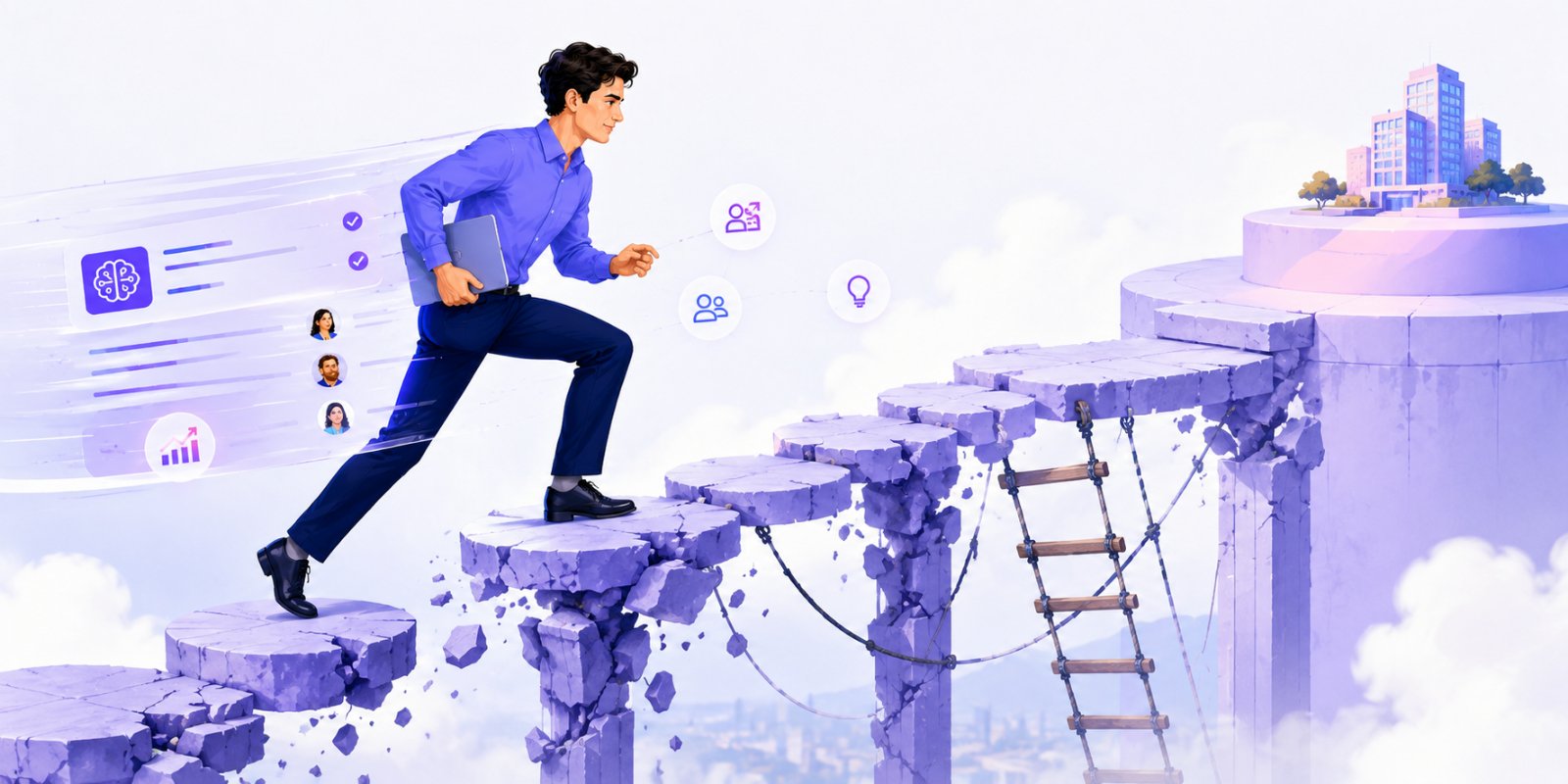
It's the exact flip side of Dreyfus. You become an expert by accumulating situations. But if AI lives all your situations for you, you stop accumulating them. You stop climbing the ladder. You stay an advanced beginner, for life, but fast. The cases that would have made you an expert, the ones that engrave themselves because you crossed them yourself, the machine absorbed them for you. It learned. You delivered. And after a while, it's no longer you who knows, it's the machine, and you're only the hand that validates without quite understanding.
Researchers have put this into an equation, at the scale of an organization: when everyone delegates to AI the very effort that produced knowledge, common knowledge stops renewing itself. They call it knowledge collapseKnowledge collapseThe erosion of institutional memory when AI accelerates execution but nothing gets capitalized.. At the scale of one person, it's exactly the same. Delegate the effort, and the learning that came with it leaves too, without a sound.
You don't lose a skill all at once. You slowly stop gaining new ones.
I saw it in myself. One evening, facing a task I did with my eyes closed ten years earlier, I realized I no longer quite knew where to begin it without help. Not from fatigue, not from lack of time. From unlearning. I'd grown so used to delegating the first step that I'd lost the first step itself. That evening, the time I'd saved over all the previous weeks suddenly seemed very dearly paid for.
And that's where the loop closes. Other people's path, the one that lifts you, isn't the tool working in your place. Borrowing a path you walk anyway, with a map, builds the expert: you make the effort, you accumulate, you climb. Having something else walk the path while you watch doesn't build you, it empties you. The same action, walking, in two opposite directions, depending on whether it's you moving forward or something moving forward for you.
The question, to close the year:
Will I have accelerated, or will I have learned?