
Practice as the primitive
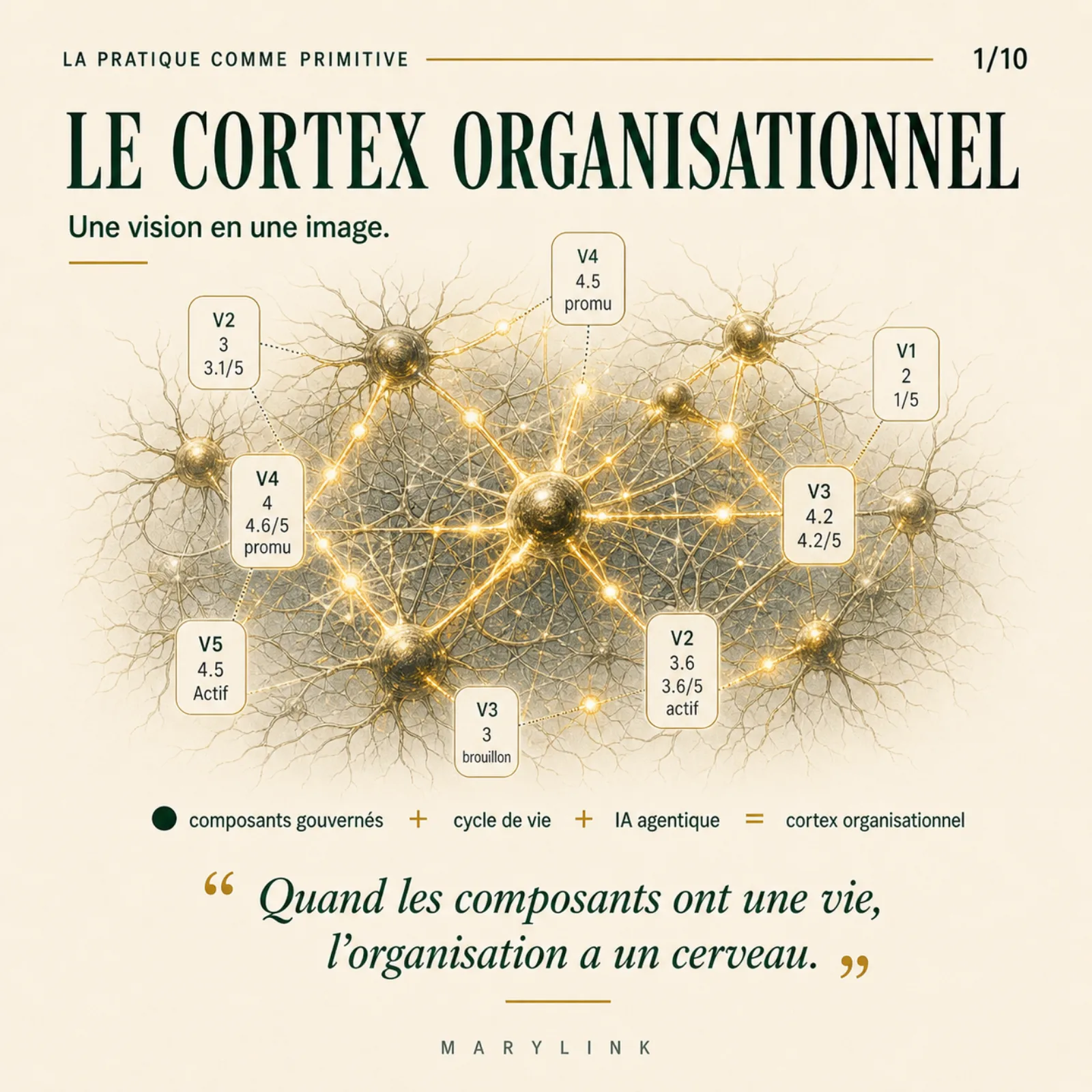
We look for the right brick of know-how in the wrong place. It isn't the prompt, too bare to survive. It isn't the document, too frozen to act. It's the practicePracticeA unit of know-how captured in Marylink: not a document but an executable structure (content, prompt, rules, style).: a business intent, its version, its author, its rights. The atomic unit an organization can finally compose on, and govern. When these components have a life, the organization has a brain.
Neither the prompt nor the context: the practice
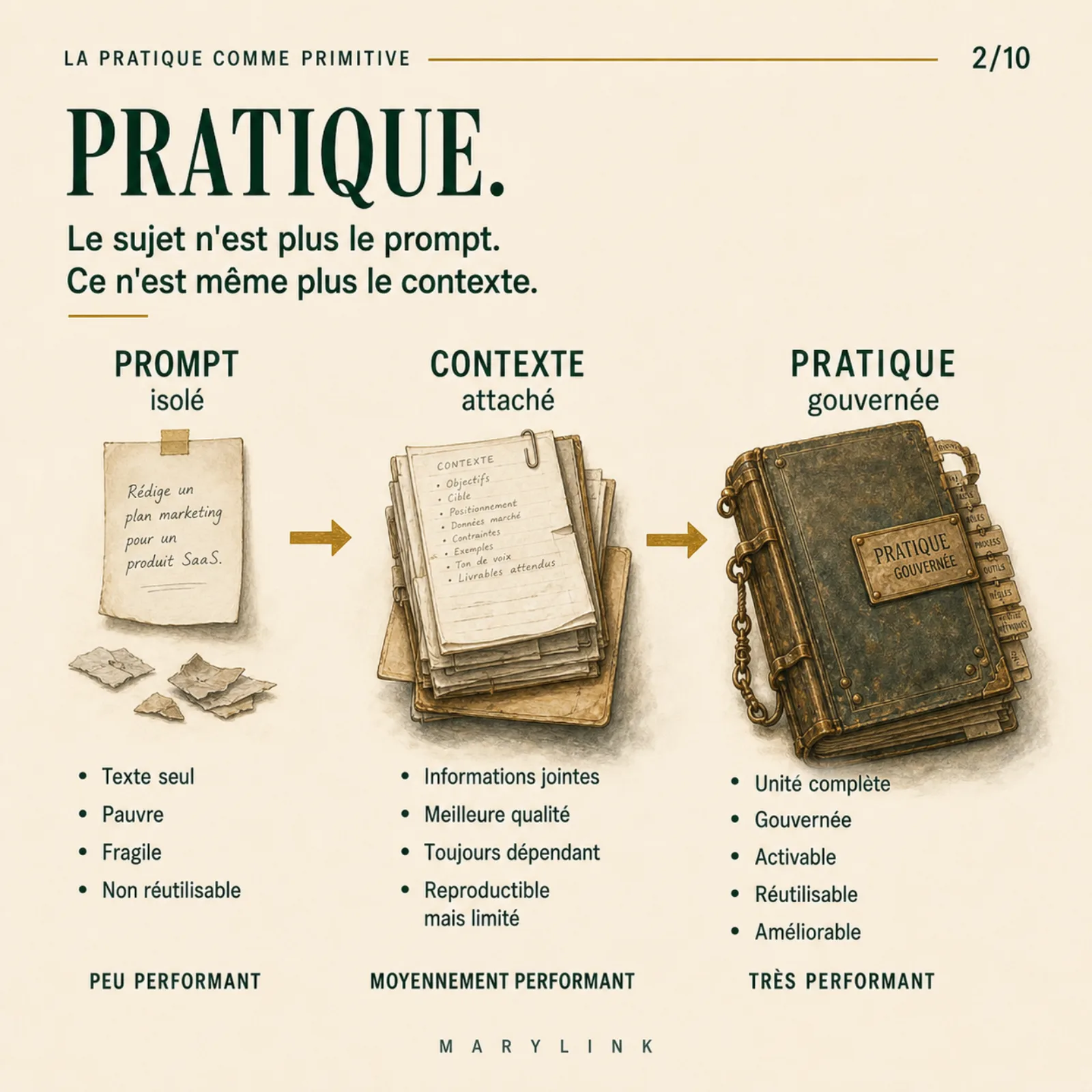
For a long time we believed the brick was the prompt. A prompt alone is bare text: thin, fragile, not reusableReuseThe same practice serving many times, across many spaces, the key measure of the Practice Graph's value.. Then we added context, attached documents, better quality, but a permanent dependency and a result still hard to replay. Each tier improves on the last without fixing the root.
The root is the unit itself. A practice is complete: it carries its intent, its version, its author, its status. It activates, reuses, improves. It's the first brick that stands up on its own.
Three axes that combine nowhere
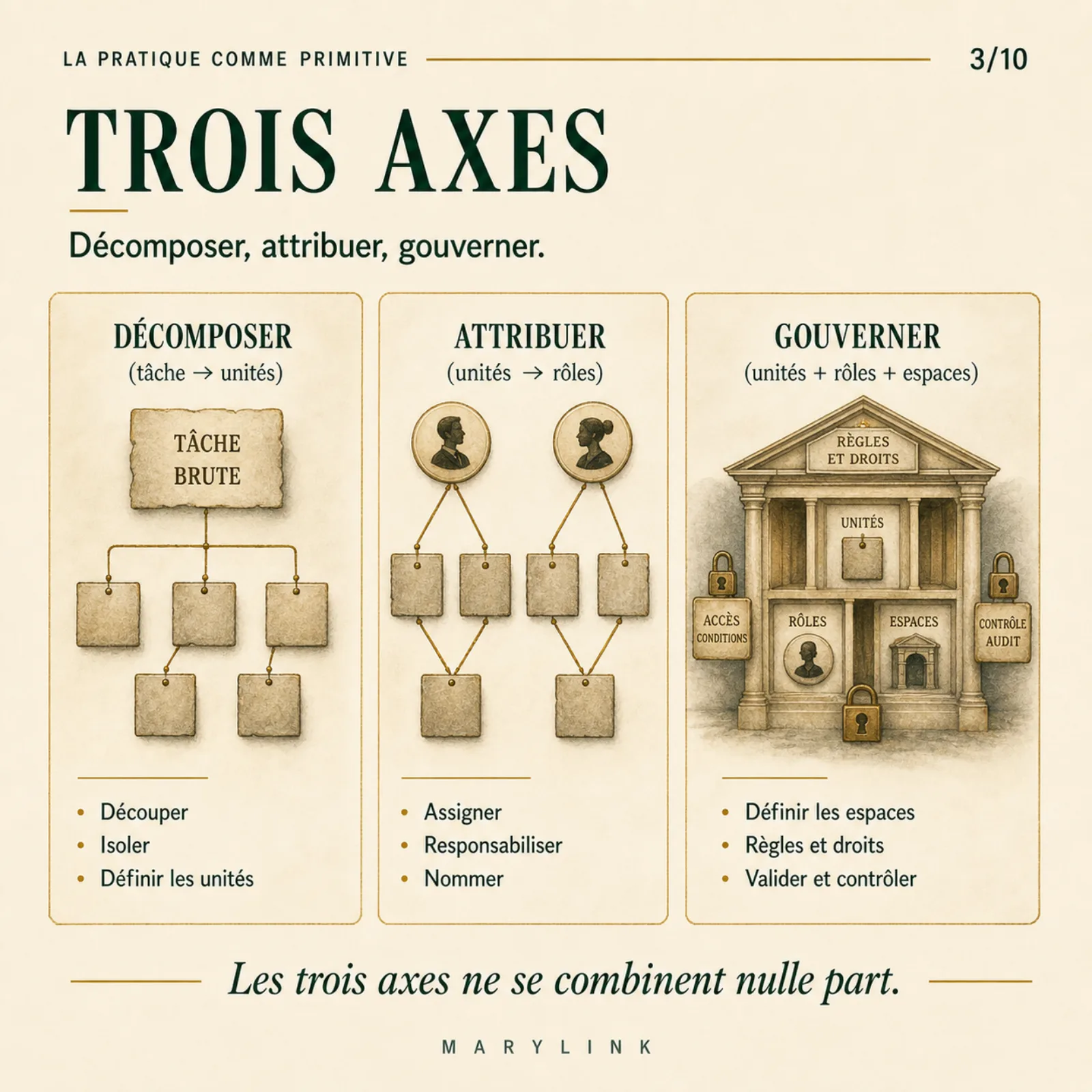
Turning know-how into a governable practice takes three distinct moves. Decompose: cut a raw task into isolable, named units. Assign: hand each unit to an accountable role. Govern: wrap the whole in spacesSpaceA workspace by domain or topic where a team publishes, shares and governs its practices., rules, access rights and an audit trail.
Each of these axes exists somewhere in the organization. The trouble is they almost never meet in the same place. Tools decompose without governing; repositories govern without activating. The practice is precisely where the three cross.
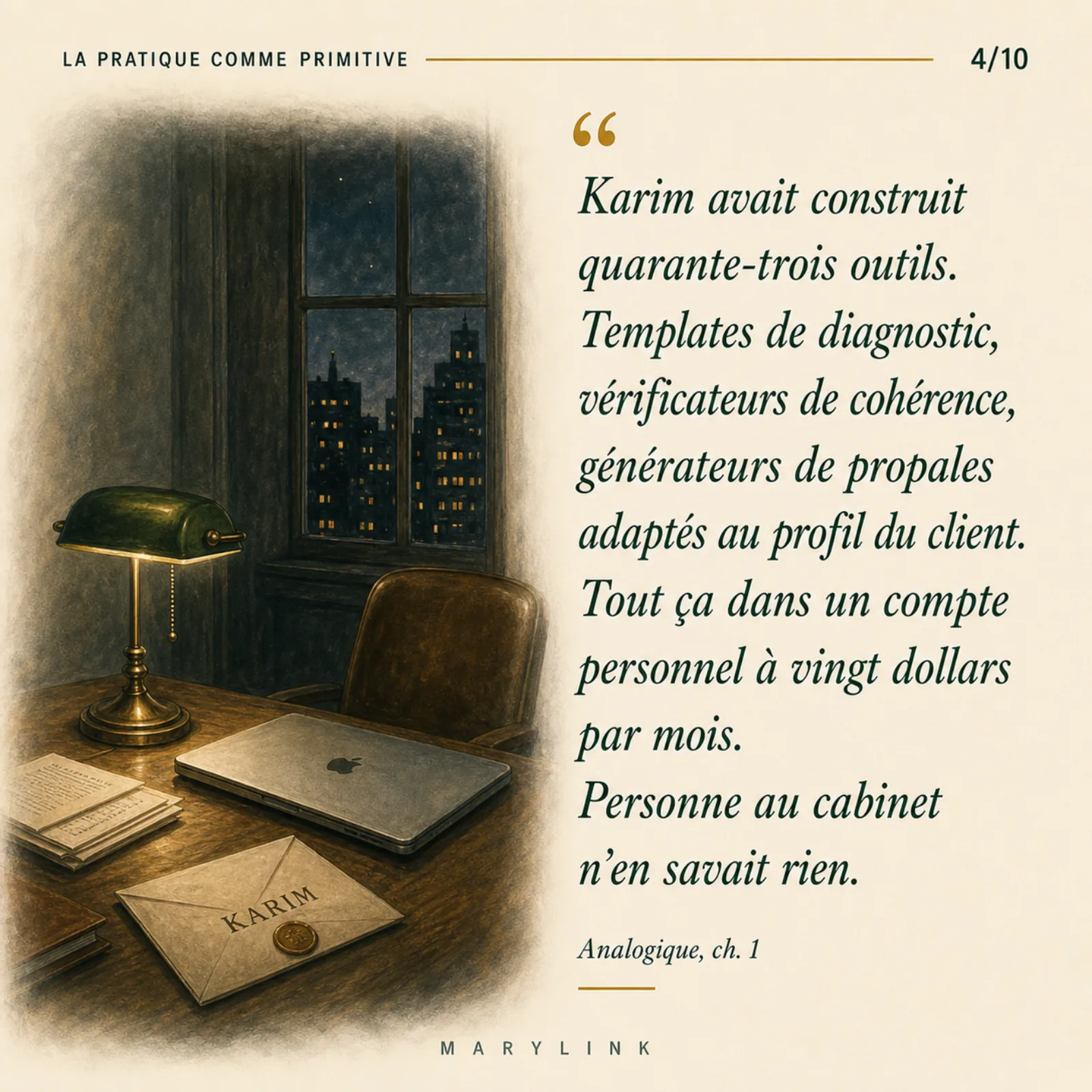
Karim had built forty-three tools. Diagnostic templates, consistency checkers, proposal generators tuned to each client profile. All of it in a twenty-dollar-a-month personal account. No one at the firm knew.Analogique, ch. 1
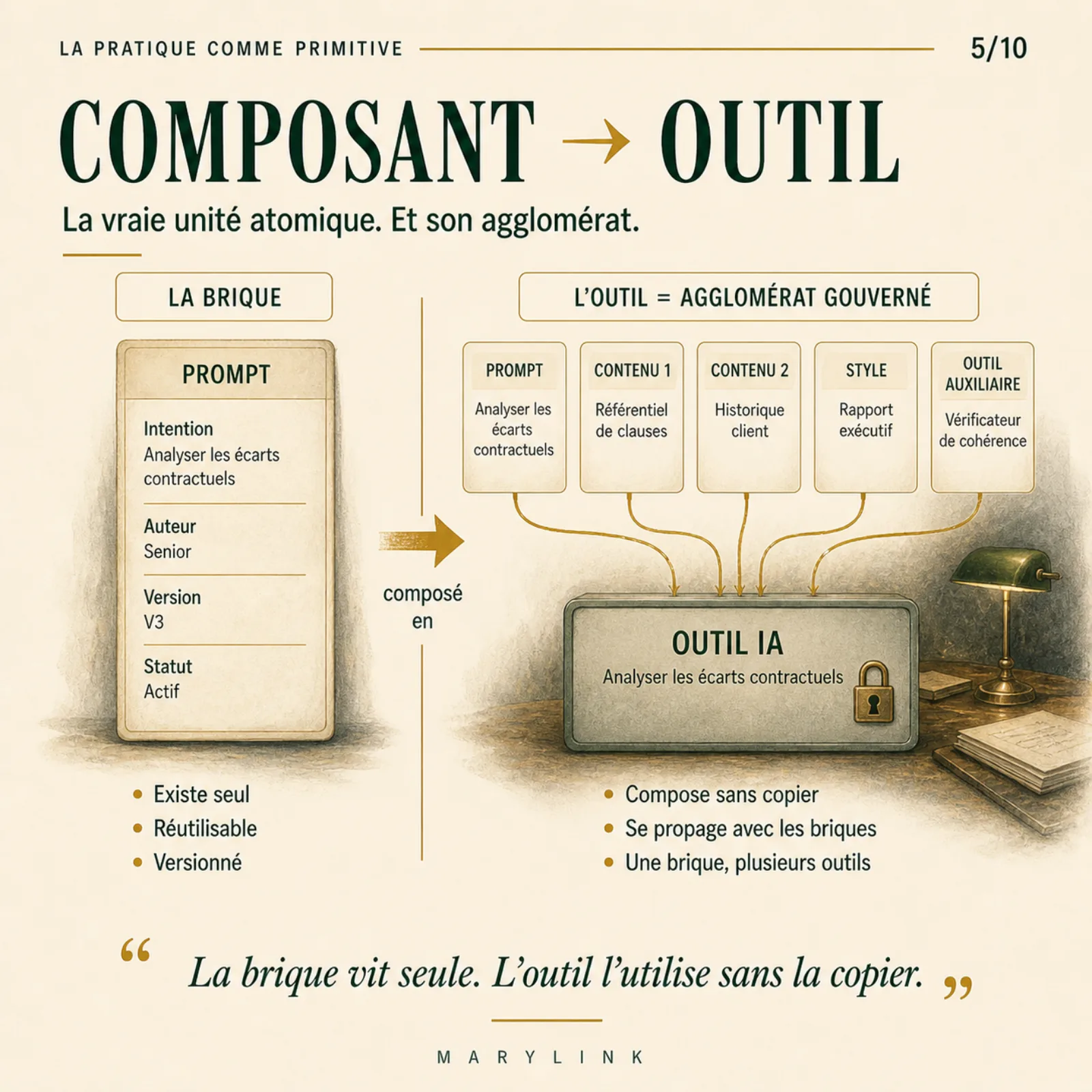
The brick lives alone; the tool uses it without copying
Once isolated, the practice becomes an autonomous component: a clear intent, an author, a version, a status. It exists independently of any tool that draws on it. An AI tool, in turn, is just a governed aggregate, a prompt, reference content, a style, auxiliary components assembled around a single intent.
The distinction is decisive. The tool composes the brick without copying it: it references it. One practice can feed many tools, and any fix propagates to all of them at once. That is what the Practice Graph makes possible: one primitive, a thousand uses.
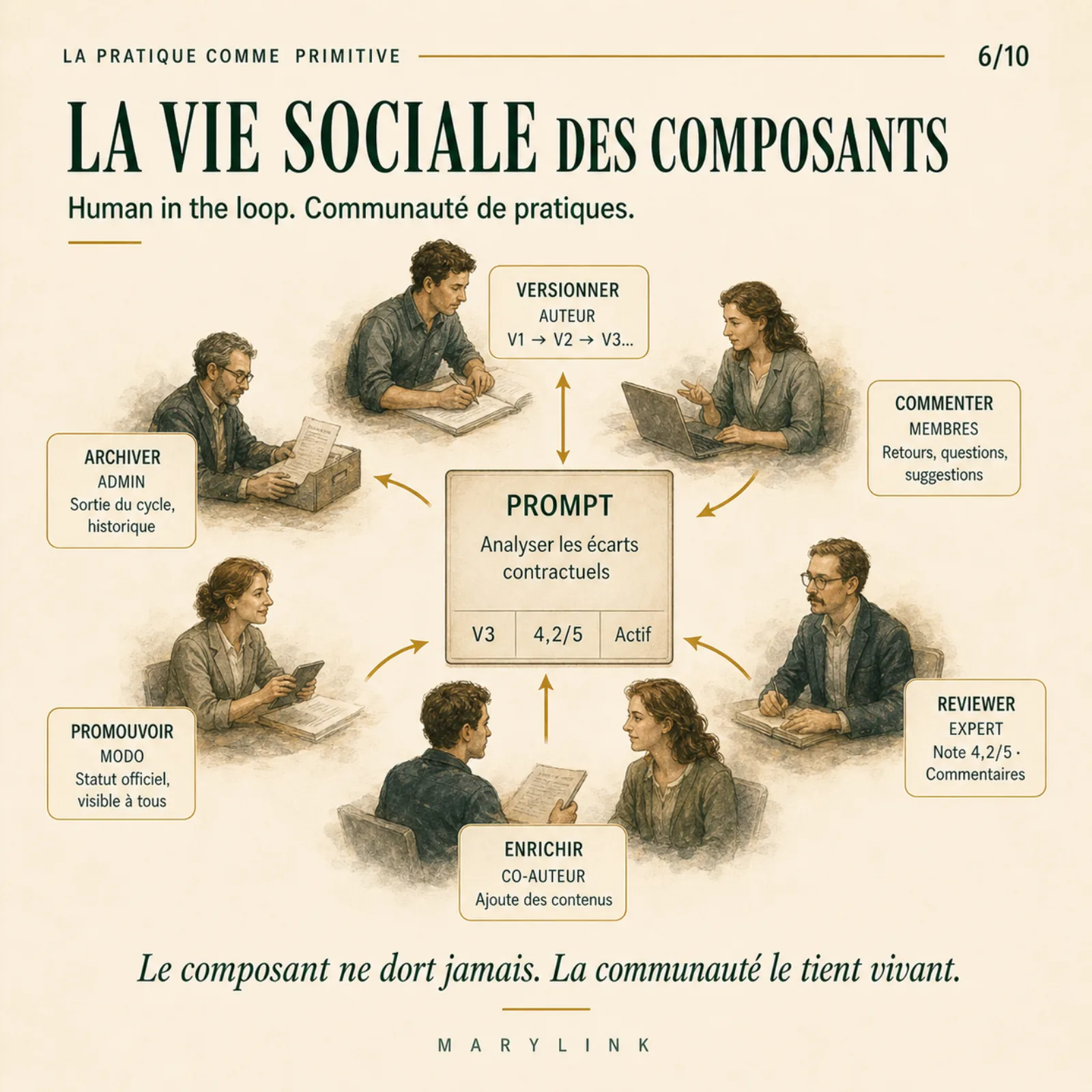
A component never sleeps
A governed practice isn't a dead file in a library. It has a social life. Roles organize around it: the author versions it, members comment, an expert reviewsReviewAn expert's assessment of a practice: score, comments and recommendations against criteria. and rates it, a co-author enriches it, a moderatorModeratorThe role that ensures the quality and compliance of a space's publications. promotes it to official status, an administrator archives it when its cycle ends.
This is the human in the loop put back in its place: not a final tick-box approval, but a community of practice that keeps the component alive. Know-how stops being an individual trace and becomes a collective object, traceable and always current.
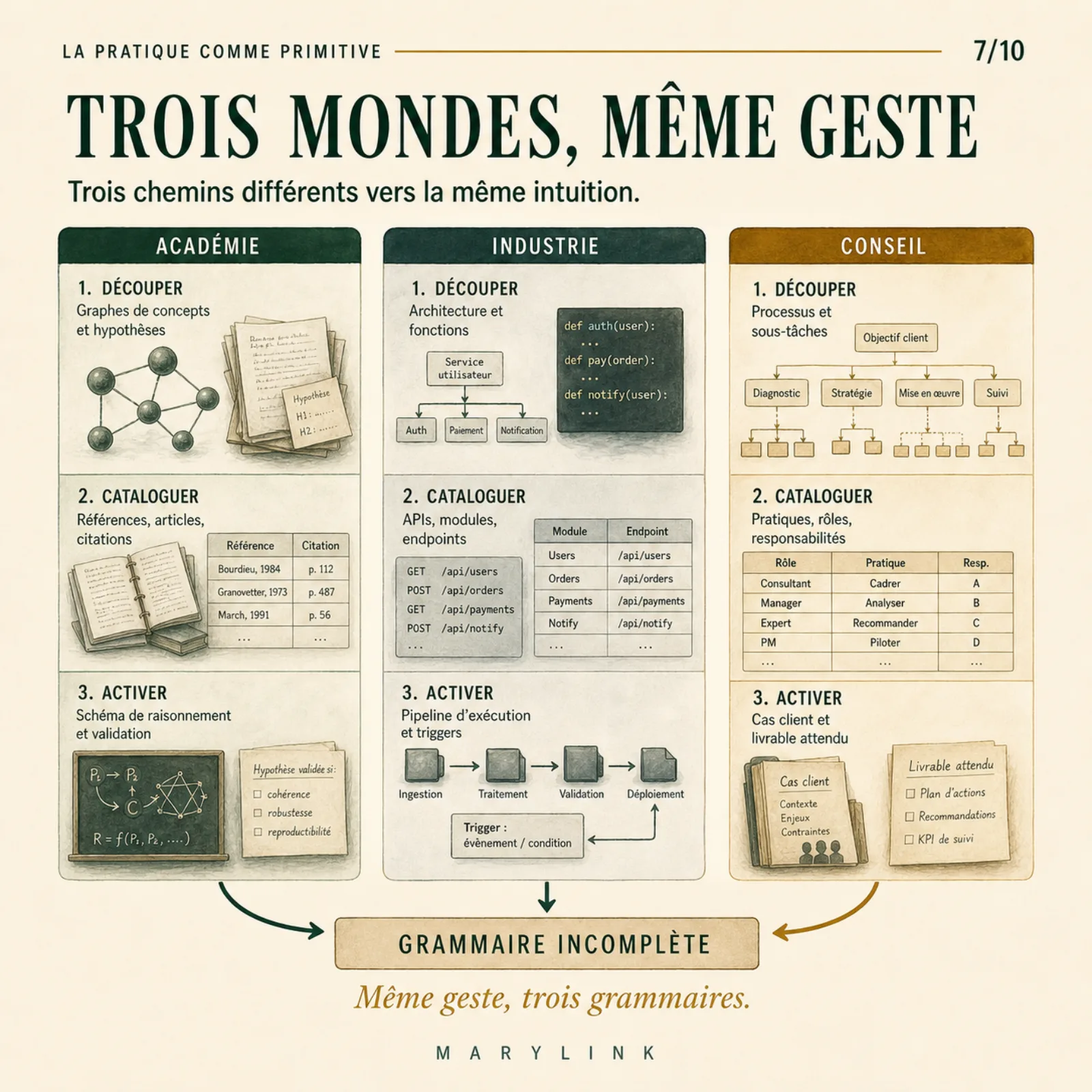
Three worlds, one move, separate grammars
The move is universal, even when unnamed. Research decomposes into concepts and hypotheses, catalogues its references, activates a validated reasoning schema. Industry decomposes into services and functions, catalogues its APIs, activates an execution pipeline. Consulting decomposes into sub-tasks, catalogues its practices and responsibilities, activates an expected deliverable.
Decompose, catalogue, activate: three worlds, one move. Yet each expresses it in an incomplete, private grammar. The CREW framework (Elmoukhliss & Mary, 2025) names that shared grammar, the condition for the move to become, at last, transferable.
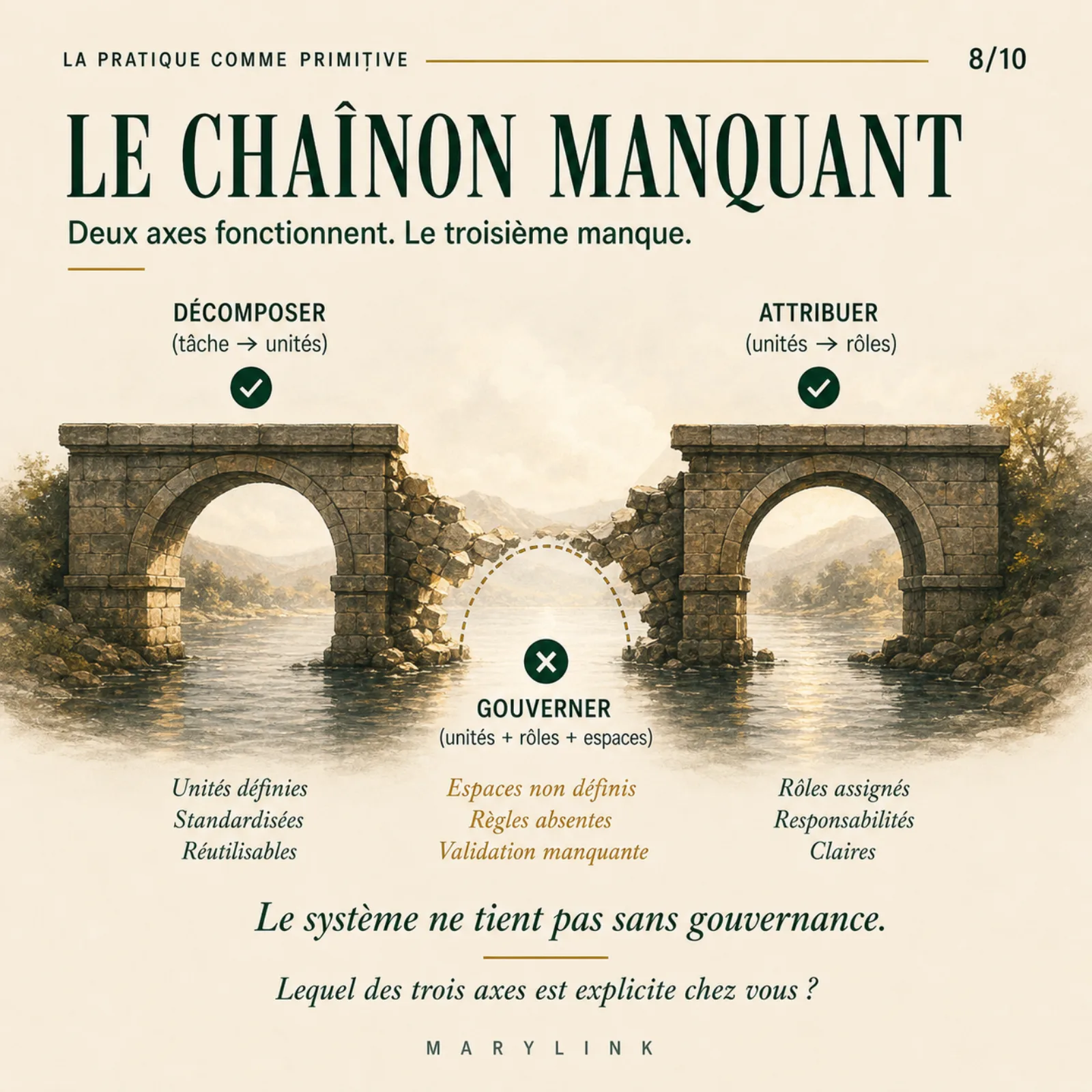
The missing link is governance
In most organizations, two of the three axes already work. We know how to decompose: units are defined, standardized, reusable. We know how to assign: roles are allotted, responsibilities clear. The third is almost always missing: governing. Spaces aren't defined, rules are absent, validation is nowhere to be found.
But an arch won't hold without its keystone. Without governanceGovernanceThe roles, validation steps and reviews that ensure the quality of shared practices., practices stay private fragments that never compose. The real question to ask isn't do we have practices?, you do, but which of the three axes is explicit in your organization.
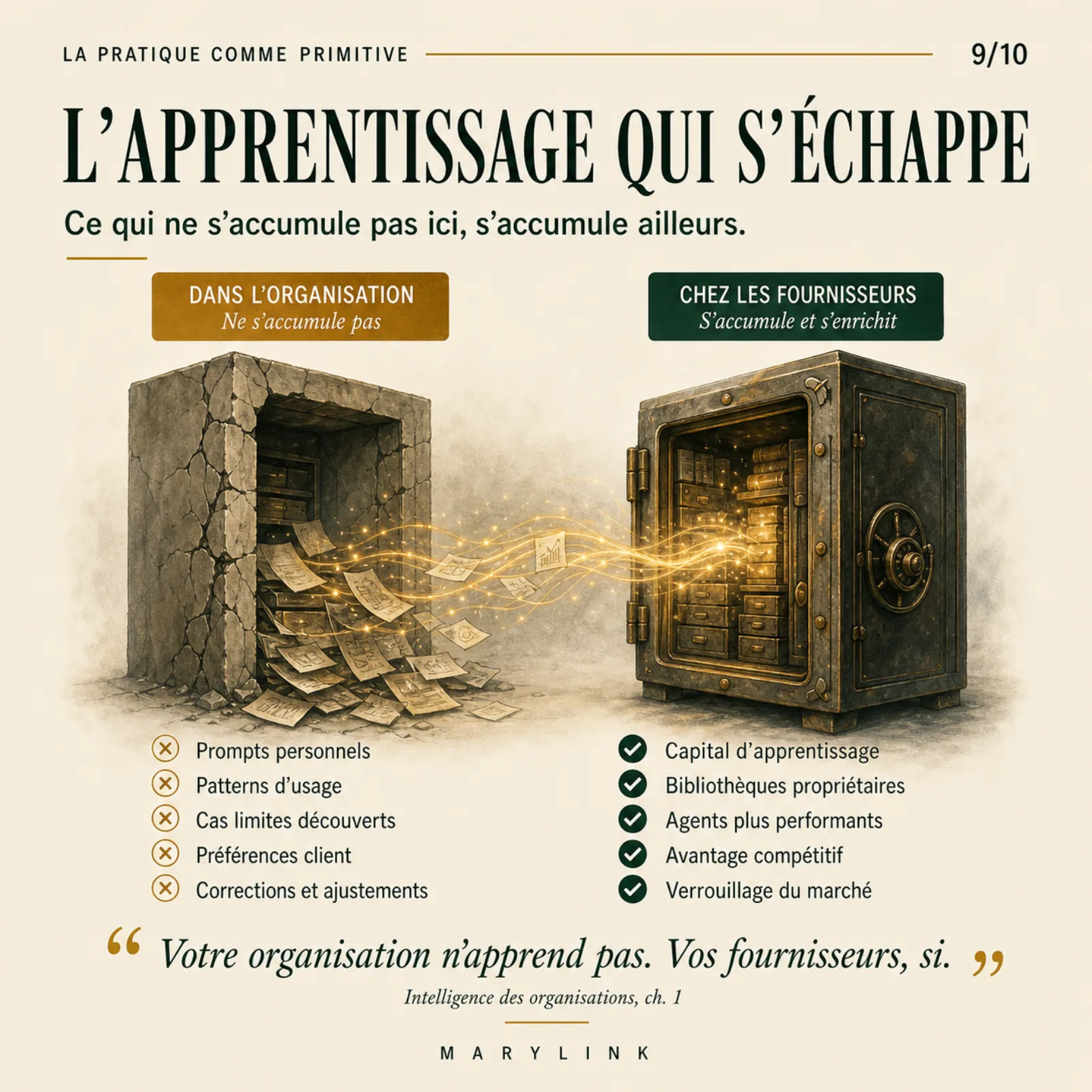
What doesn't accumulate here accumulates elsewhere
Learning doesn't vanish: it leaks. As long as practices live in personal accounts, the organization accumulates nothing, no usage patterns, no discovered edge cases, no corrections, no client preferences. All of it leaves with the person or dissolves in private conversations.
But this capital doesn't evaporate: it accumulates at the AI vendors, who turn it into proprietary libraries, sharper agents, a competitive edge. Your organization isn't learning. Your vendors are. Capturing the practice as a primitive means keeping that learning at home.
The next stake is managing practices
The whole market is working on context management today: wider windows, memory, retrieval augmentation. Useful, but it's the floor below. The real next stake is managing practices, the governed components everything composes on. The question is no longer whether your best know-how exists. It does, scattered. The only question that matters: how many Karims do you have?