
The silent orchestration
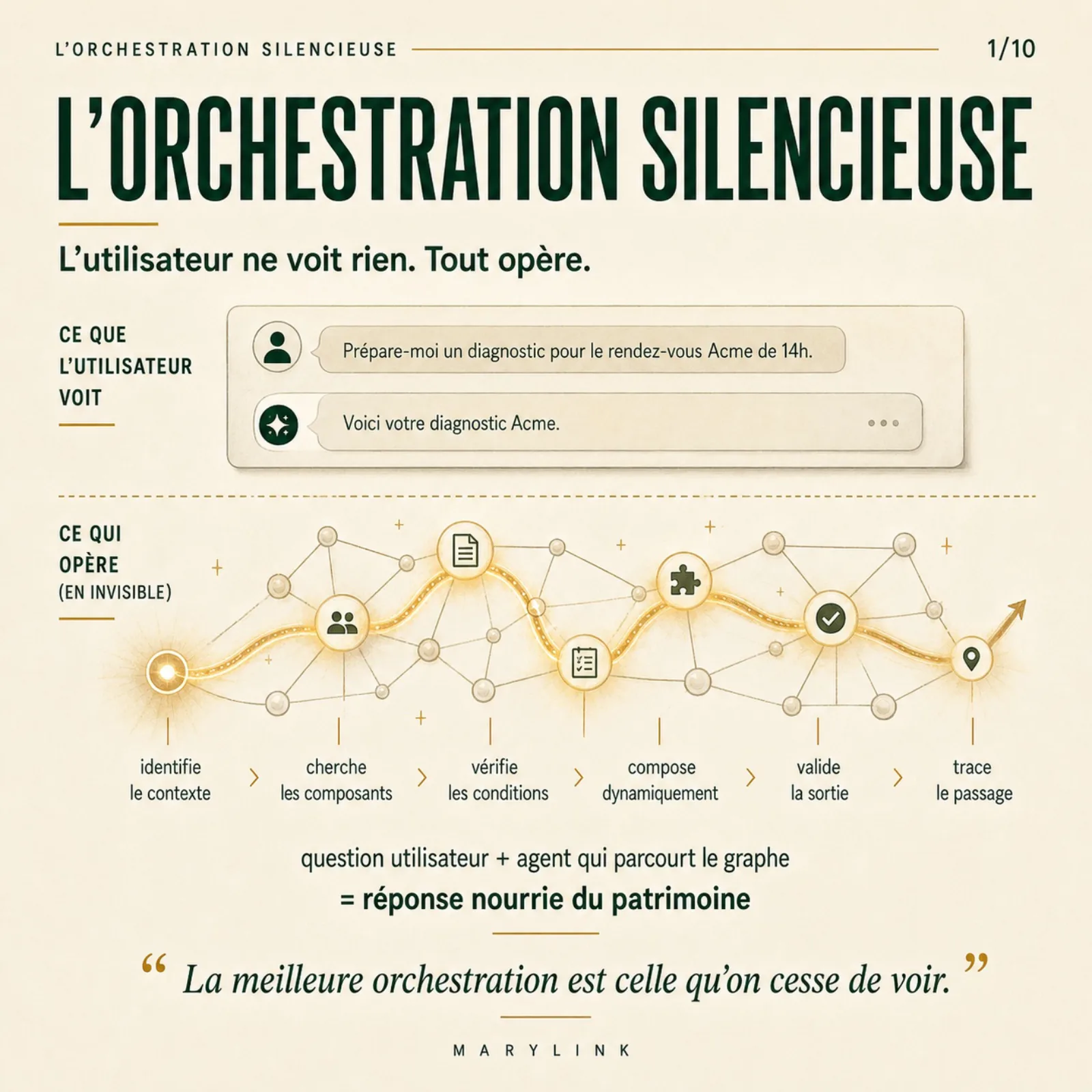
The user asks their question as before. The answer comes back, right, contextual, sourced. Between the two, nothing shows, and everything operates. The agent doesn't "know" the answer: it walks a graph of governed practicesPracticeA unit of know-how captured in Marylink: not a document but an executable structure (content, prompt, rules, style)., reads their conditions of use, and composes. The best orchestration is the one you stop noticing.
The user's gesture doesn't change
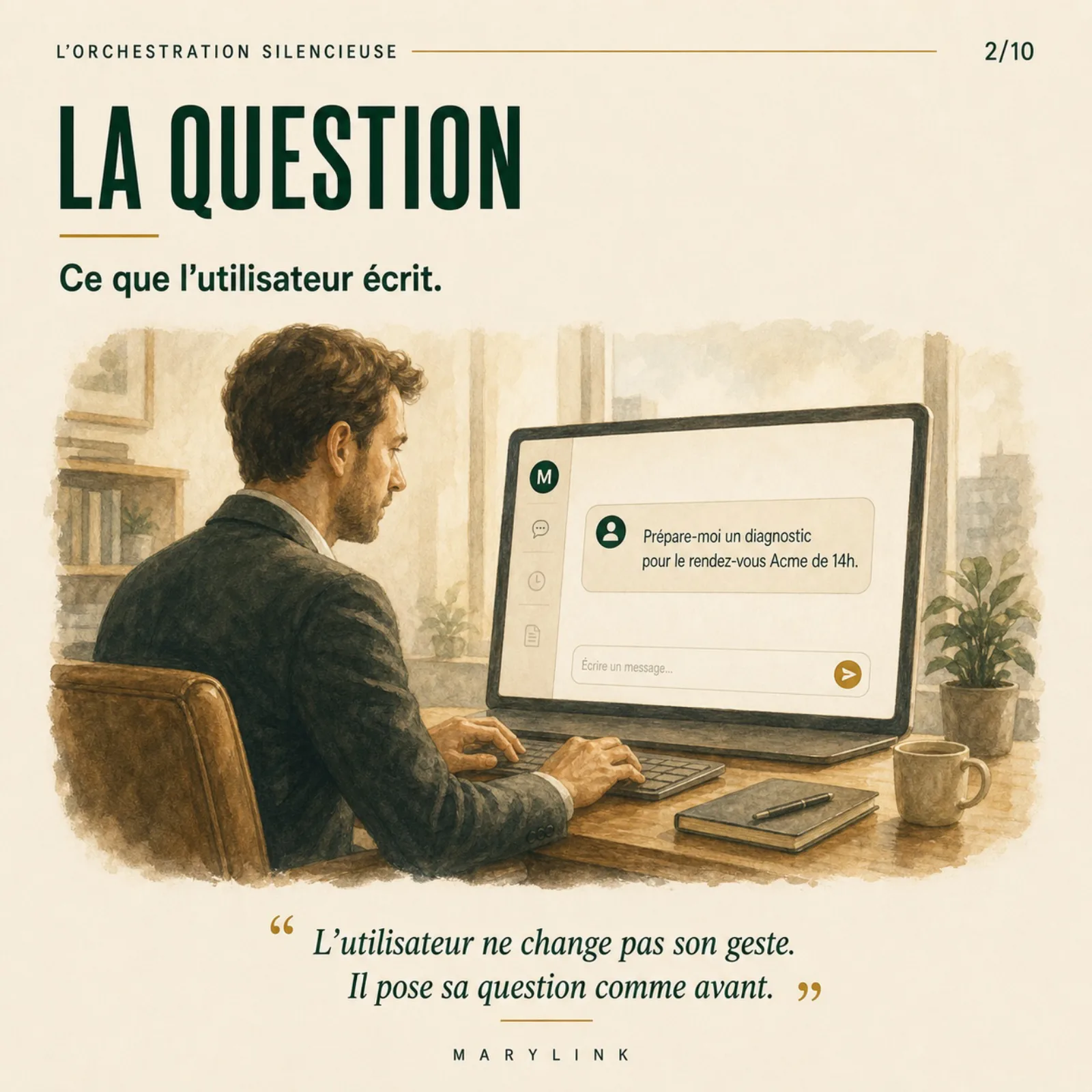
It all starts with an ordinary sentence: "Get me a diagnostic ready for the 2pm Acme meeting." No syntax to learn, no menu to explore, no prompt to whittle down. The person writes what they want, the way they'd have said it to a colleague.
That's the first principle of good orchestration: it doesn't push its complexity onto the user. The gesture stays the one from before. Everything happens behind the question.
Seven rungs between question and answer
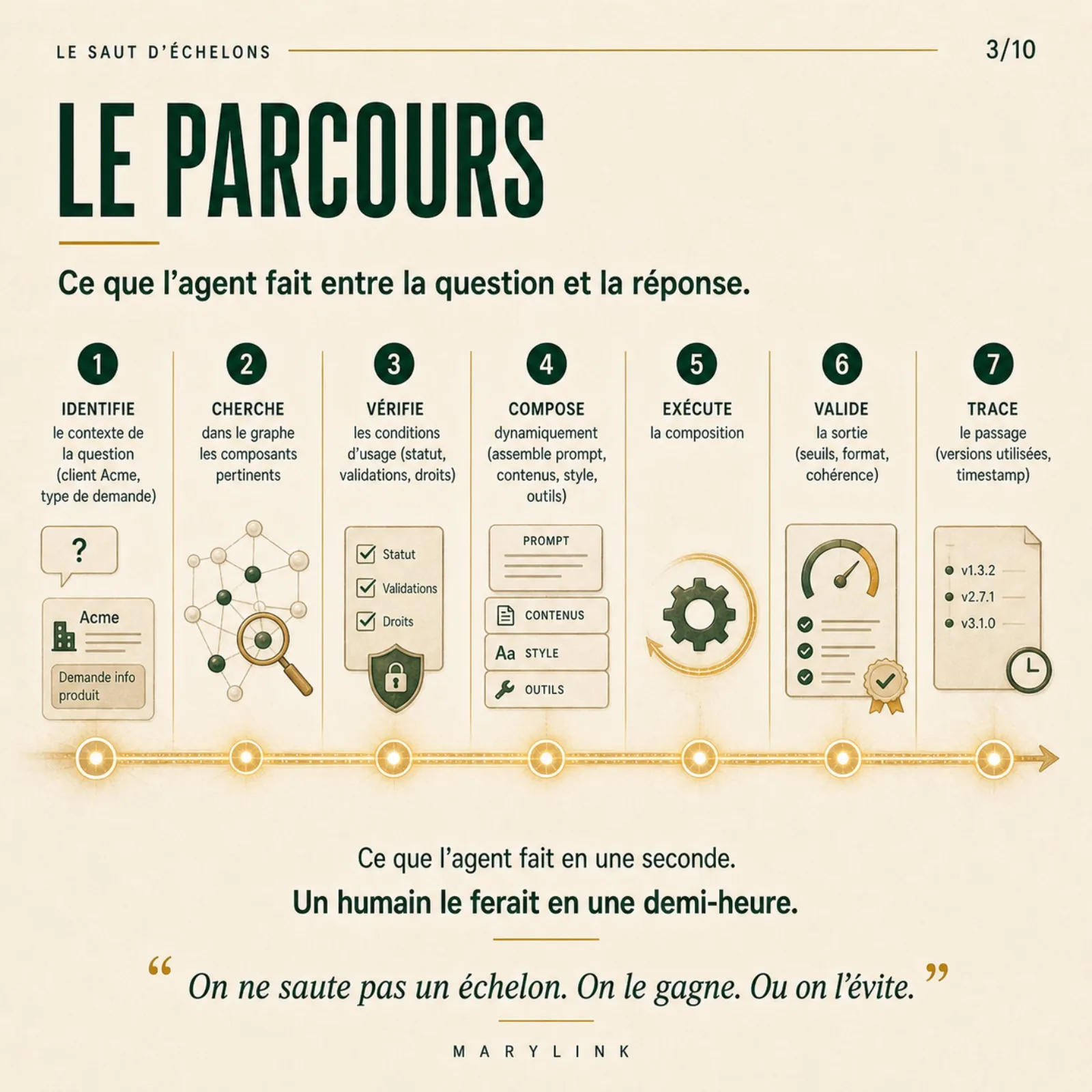
What looks instant is in fact a path. The agent identifies the request's context, searches the graph for the relevant components, checks their conditions of use, composes them for this query, executes, validates the output against thresholds, then traces the run. Seven moves, chained.
A skilled human would do the same: find the right method, the right client reference, the right tone, check consistency. It would take them half an hour. The agent skips none of these rungs, it climbs them in one second.
A governed component states what it's for
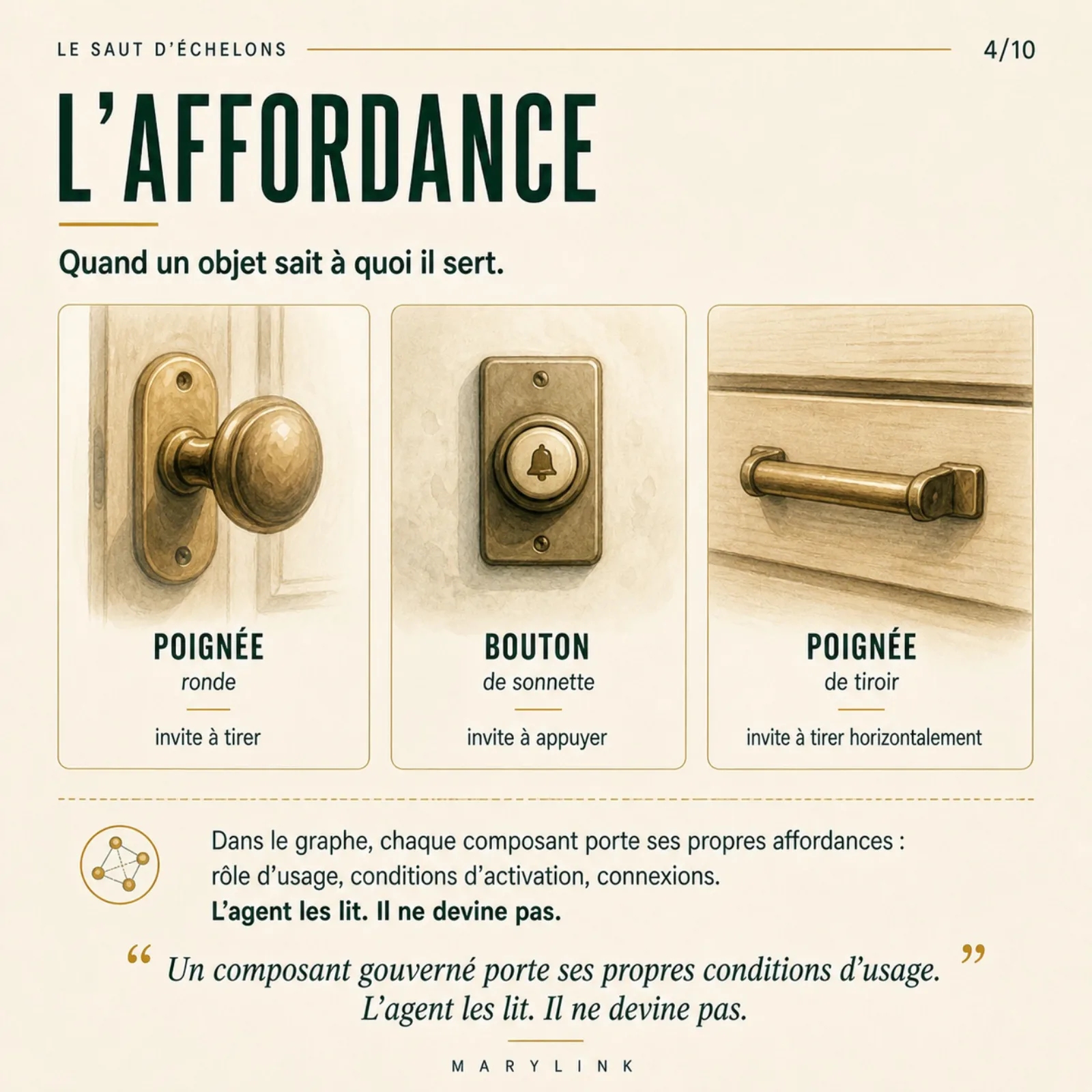
A round knob invites a pull, a doorbell a press: a well-made object announces its use. Ergonomists call this an affordance. In a graph of practices, every component carries one: its role, its activation conditions, its connections, its status.
So the agent doesn't have to guess whether a method applies or whether a reference is current: the information is written into the component itself. It reads it. That's the whole difference between a system that interprets at random and one that leans on a governed graph of practices.
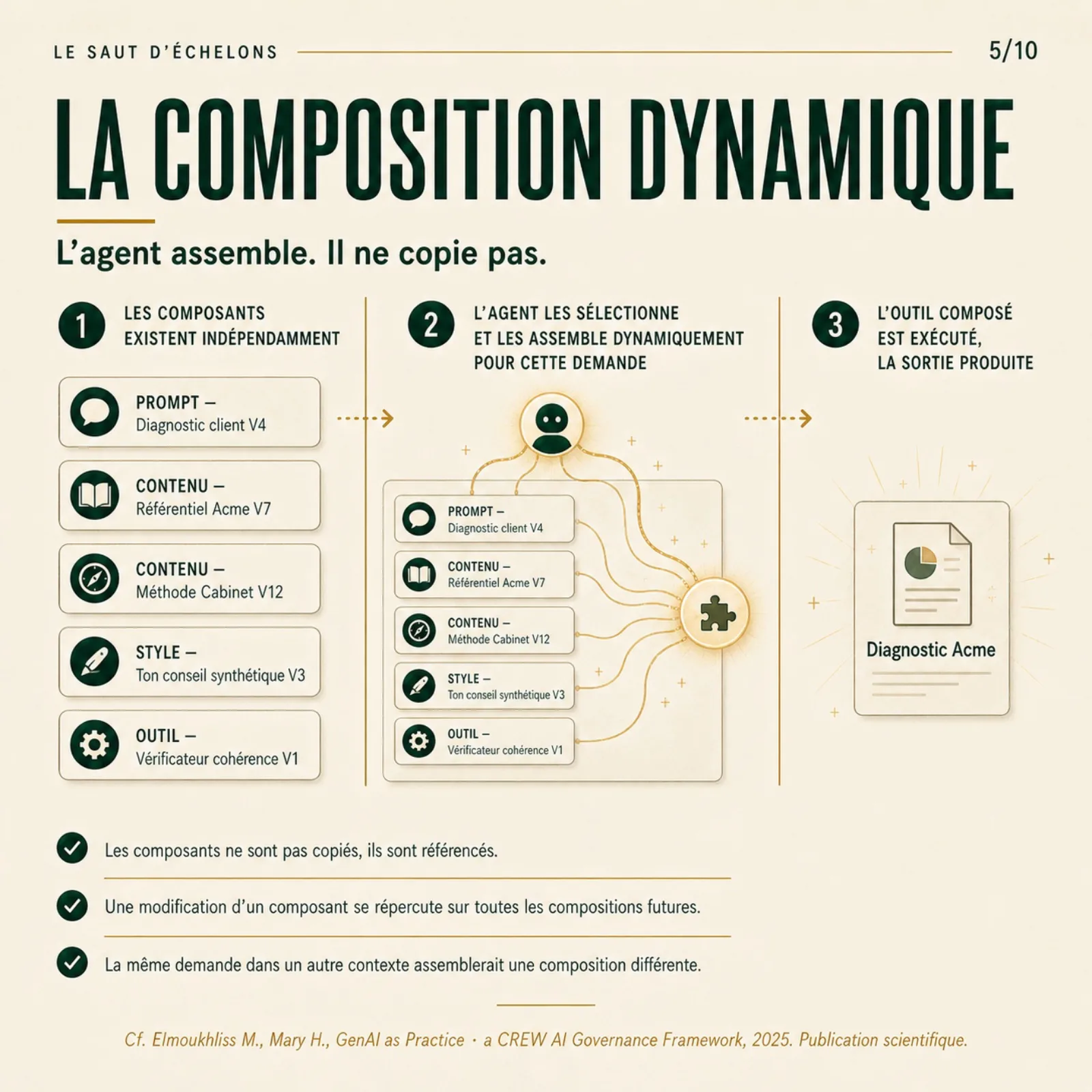
The agent assembles, it doesn't copy
The components, a "Client diagnostic" prompt, an Acme reference, a firm method, a tone, a consistency checker, exist independently of one another. The agent selects them and assembles them for the request at hand. It duplicates nothing: it references.
The consequence is decisive. Fixing one component instantly updates every future composition that uses it. And the same question, asked in another context, would yield a different assembly. This is the dynamic composition Elmoukhliss and Mary describe in the CREW framework: generative AI not as an oracle, but as a tooled practice.
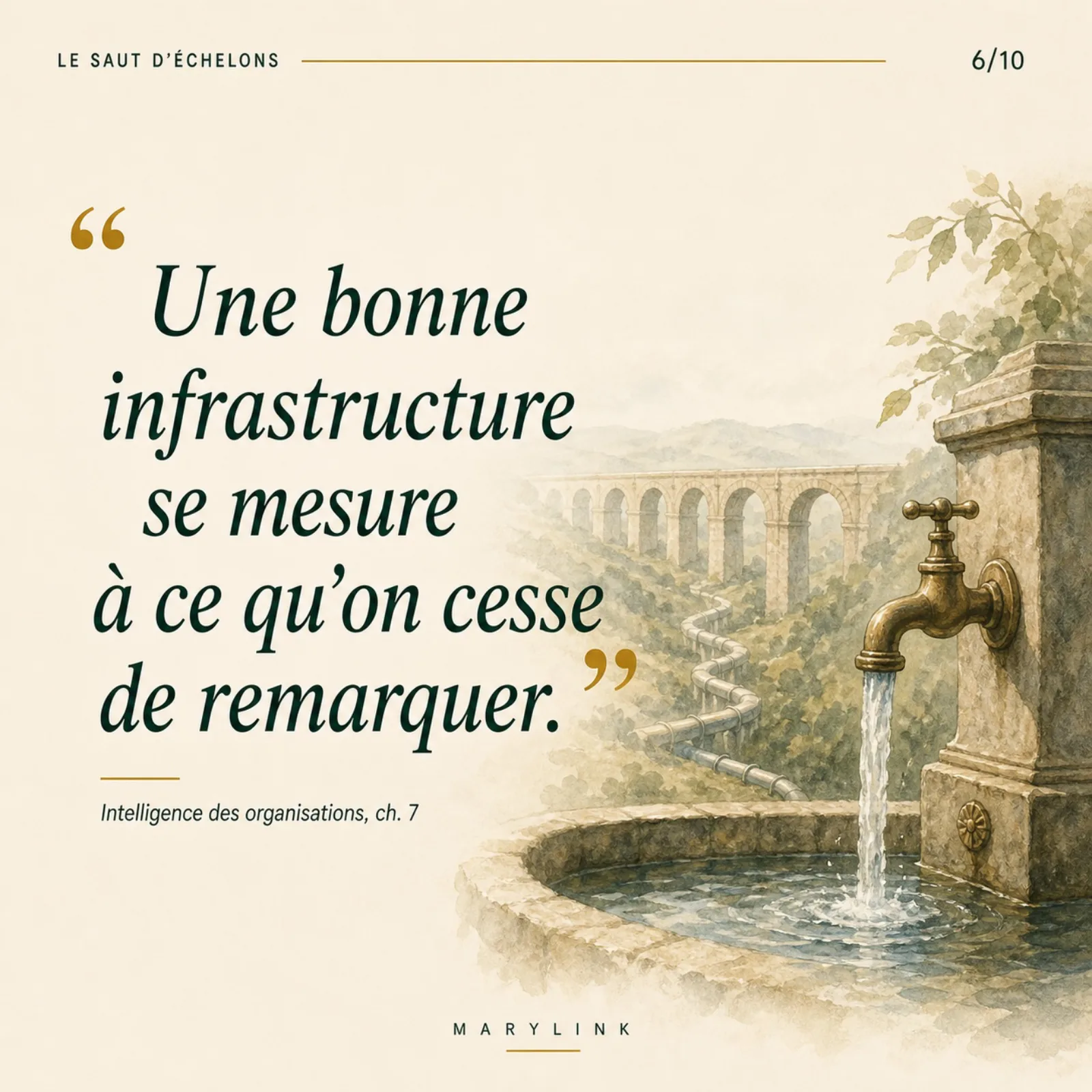
Good infrastructure is measured by what you stop noticing.Intelligence des organisations, ch. 7
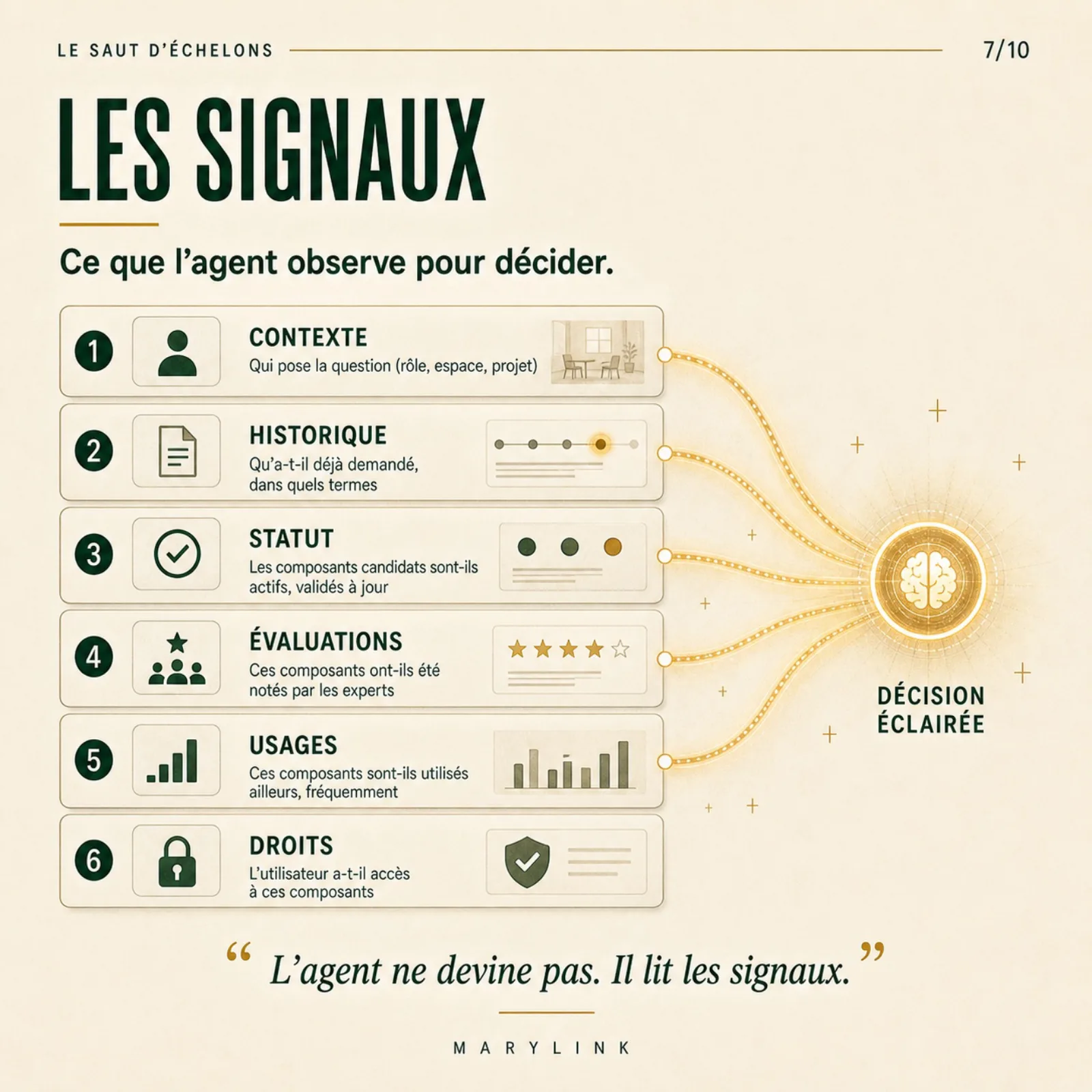
The agent doesn't guess, it reads signals
What does the agent rely on to pick one component over another? On objective signals, not on a hunch. The context (who's asking, in which spaceSpaceA workspace by domain or topic where a team publishes, shares and governs its practices., which project). The conversation history. The status of the candidate components, are they active, validated, current. The ratings left by experts. How often they're used elsewhere. And the user's access rights.
None of these signals is guessed: all are carried by the graph and readable on demand. That's what separates a plausible answer from a governed one.
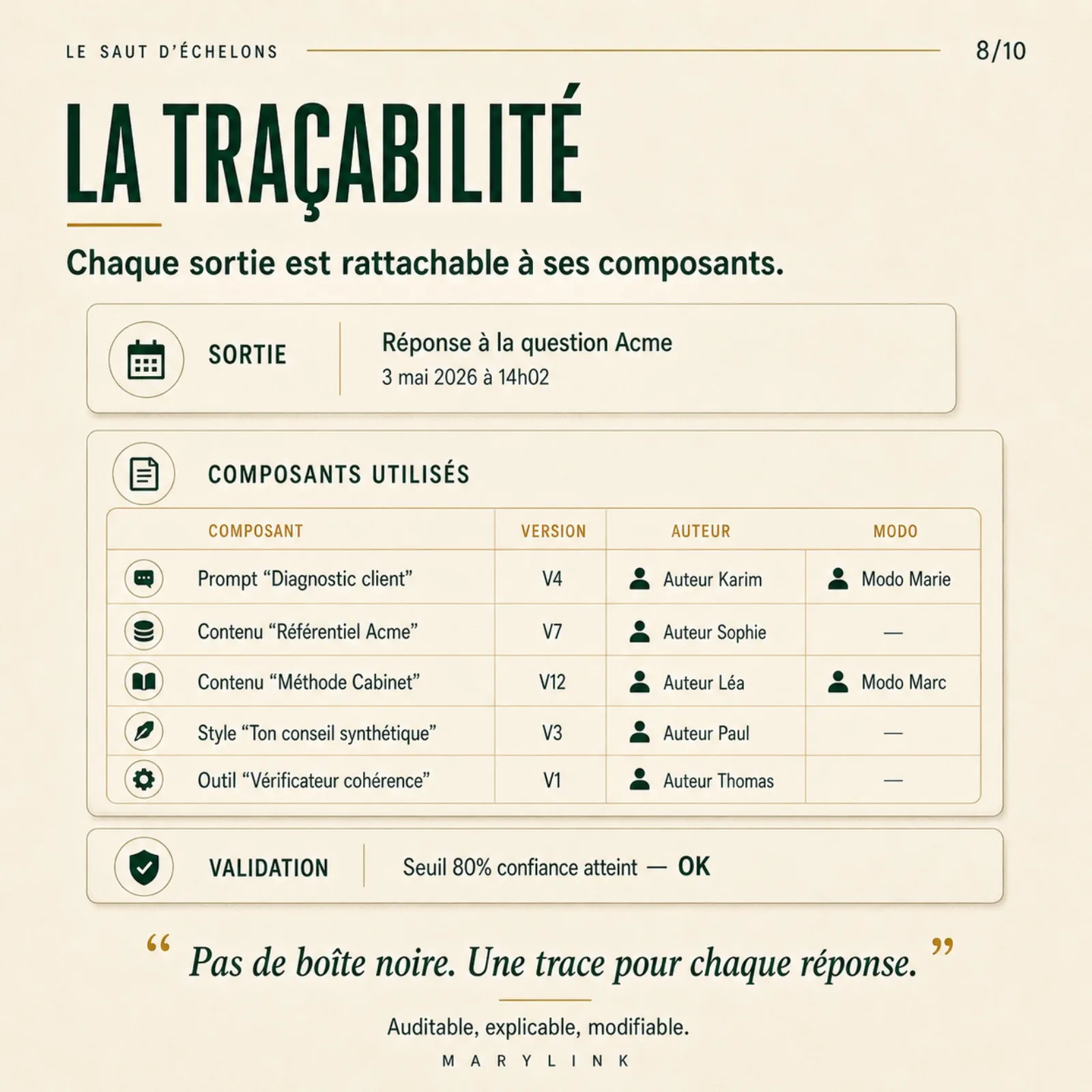
No black box, a trace for every answer
In the end, the output isn't a text dropped from nowhere. It's tied to the exact list of components that produced it: the prompt at version 4, the Acme reference at version 7, the firm method at version 12, their authors, their moderators, the confidence threshold reached. Timestamped.
This is what most AI assistants can't do: say why they answered as they did. Here, every answer is auditable, explainable and editable. You don't patch a hallucination, you fix a component, and every later answer benefits.
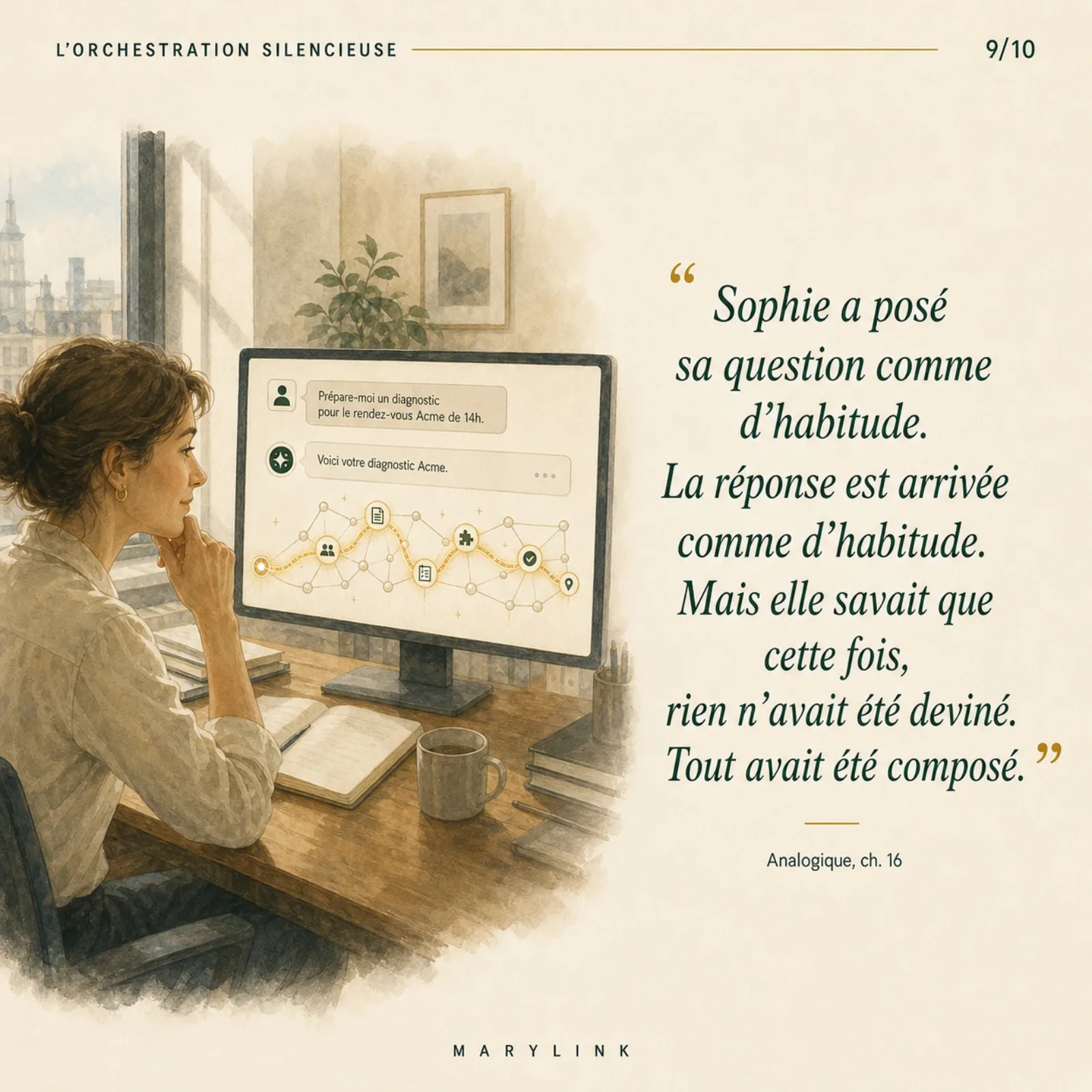
In Analogique, Sophie asks her question as usual. The answer comes as usual. Nothing on screen betrays what happened underneath. And yet she knows it now: this time, nothing had been guessed. Everything had been composed, out of the practices she and her colleagues had patiently fed into the graph.
The change isn't in the gesture. It's in what answers, and in the trust you can place in it.
The tool is invisible, the asset base speaks
When orchestration succeeds, you stop noticing it. What stays visible is the answer, and behind it, the organization's governed know-how, speaking through the agent. So the real question is no longer which AI model do you use, but: what speaks, when you speak?