
The living fabric
We assume that storing everything in a tidy graph is enough to own an asset. It isn't. A graph with no one to feed it, correct it and grow it is just one more library, elegant, ordered, and dead. What keeps know-how alive isn't the structure: it's the people who weave it. And for them to weave, you need roles, rules and a life cycle. Here is that grammar.
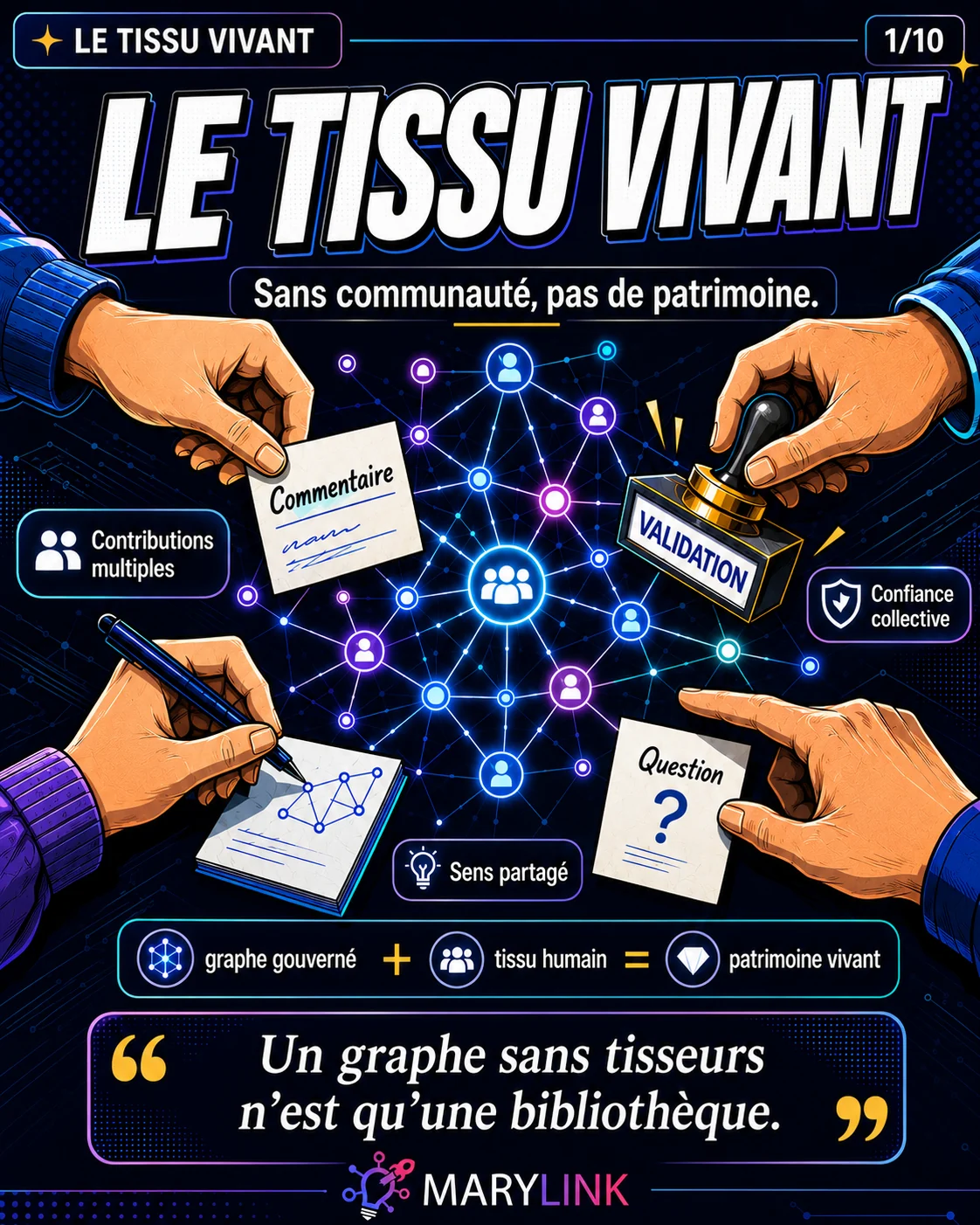

Six roles, one grammar
For knowledge to circulate, you need to know who does what. Six roles are enough. The author creates a component; the co-author enriches it; the expert rates its quality; the moderatorModeratorThe role that ensures the quality and compliance of a space's publications. approves its promotion; the admin runs its life cycle; and the community comments, flags, requests. None of these is a hierarchical title: they are gestures.
One person can hold several roles depending on the moment, and a single component draws on many of them across its life. It's this shared grammar that turns a pile of individual initiatives into collective production.

One component, six hands, a life cycle
A useful component is never one person's work; it passes through a chain of hands. T1, the author writes V1. T2, a co-author enriches it. T3, the community comments. T4, an expert rates it, say 4.2 out of 5. T5, the moderator promotes it to an official version. T6, the admin archives it when its cycle is complete. Each stage leaves a trace: who, when, why.
The idea is not new. Researchers have long studied communities of practicePracticeA unit of know-how captured in Marylink: not a document but an executable structure (content, prompt, rules, style)., where knowledge is forged through participation and negotiation rather than decree. What Marylink adds is making that cycle explicit and traceable inside the practice graph, instead of leaving it implicit in the corridors.
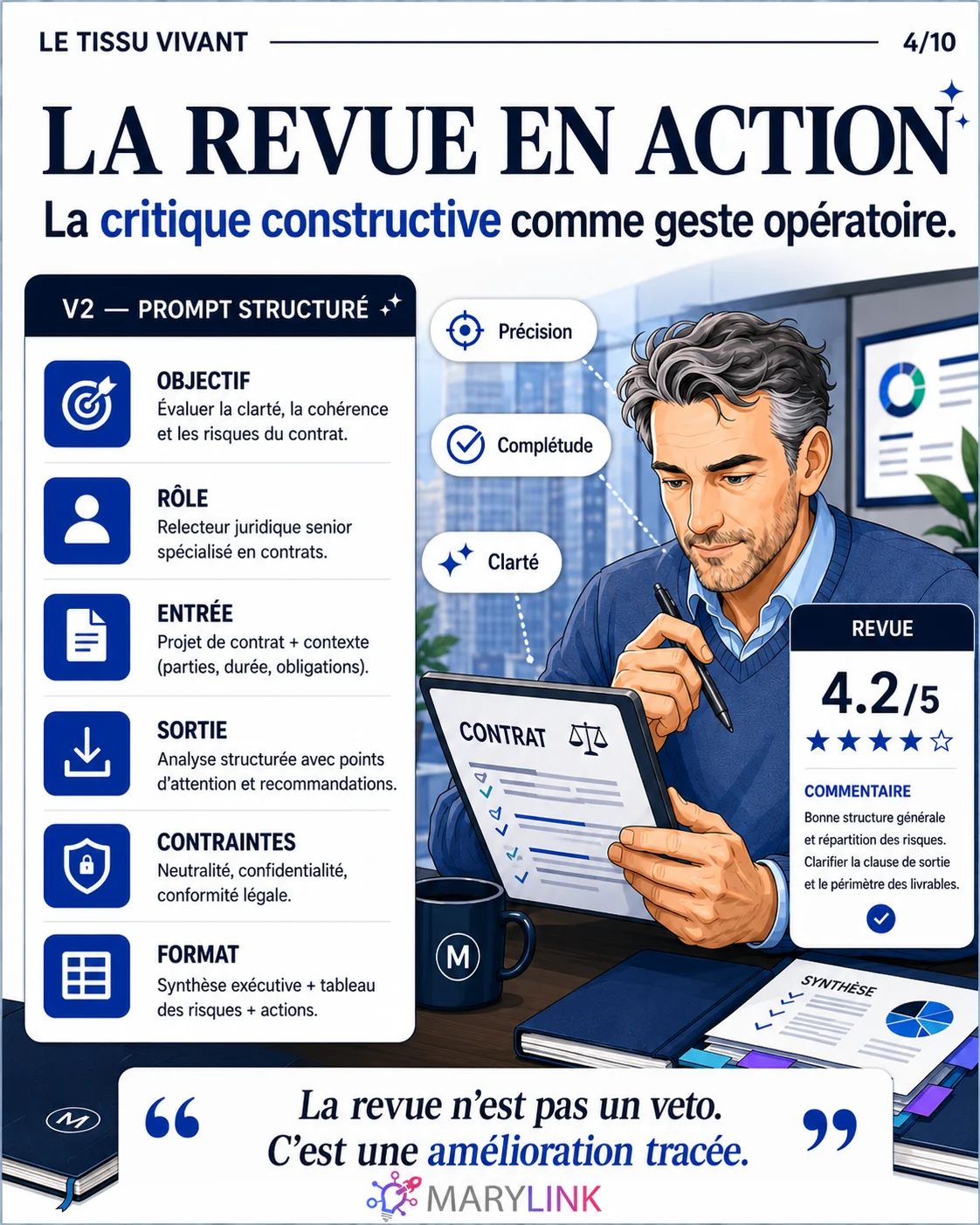
Review is traced improvement, not a veto
In most organizations, critique of someone's work takes two forms: polite silence, or a flat refusal. Both are sterile. Reviewing a component works differently: the expert scores it (4.2/5), names what's missing, a level of granularity, criticality criteria, a tone instruction, and explains why. Every remark is pinned to a specific version.
The result isn't a judgment on the author, but a trace of improvement: the next version knows exactly what to fix, and everyone sees why. Critique stops being a wall; it becomes a path.

Promotion is earned, not decreed
Not every component is meant to become a reference. It crosses three states. Draft: still being written by the author. Active: validated by an expert and reusableReuseThe same practice serving many times, across many spaces, the key measure of the Practice Graph's value. by others. Official: promoted by the moderator, the firm's reference status. Moving to the next stage isn't a click: it depends on conditions, a score above a threshold, a number of confirmed uses, an explicit validation.
This is the difference between a wiki, where everything carries equal weight, and an asset, where the status of a piece of knowledge reflects its real reliability. Governed promotion avoids both traps: the all-official that drowns the good in the mediocre, and the official-by-decree that doesn't survive contact with use.

An access system manages security. A role system governs the production of knowledge.Intelligence des organisations, ch. 3

The author creates, the editor connects
Two roles structure the fabric, and they must not be confused. The author creates: writes, revises, proposes, doubts, and owns the content. The editor accompanies: reads, annotates, validates, requests revisions, and guards overall coherence. One produces the matter; the other ensures it fits the rest without contradicting it.
Separating these two gestures protects the author from self-censorship, they can propose without having to arbitrate everything alone, and gives the editor a real lever over collective quality. Without an author, no matter. Without an editor, no asset.

This is where the whole apparatus pays off. Karim, a senior, created a component in August 2025 and enriched it in October. Marie commented on it in November. An expert rated it 4.2/5 in December. The moderator promoted it to official in January 2026. Then Karim left.
In most organizations, his knowledge would have walked out the door with him. Here, his tool stayed, versioned, rated, documented. In March 2026, Léa, a junior, picked it up and moved it forward: V6. She didn't start from scratch; she started from the latest version, standing on the entire history. Karim left. His tool stays. Léa carries it forward.

Six months after Karim left, Léa took over his proposal generator. She commented on it, improved it, enriched it. The expert scored it 4.5 out of 5. The moderator promoted it to official. Karim had never signed his tool that way. The organization did.Analogique, epilogue

The graph keeps, the community weaves
A governed graph is necessary: it's what keeps the knowledge, versions it, makes it searchable and reliable. But it isn't enough. What makes an asset living is the community that weaves it, those who create, reviewReviewAn expert's assessment of a practice: score, comments and recommendations against criteria., promote and transmit. The structure conserves; the people keep it moving. It's the same intuition as the CREW framework: knowledge only exists as long as it is practiced. So the real question isn't whether your graph is tidy. It's: who are your weavers?