
Built-in inelasticity
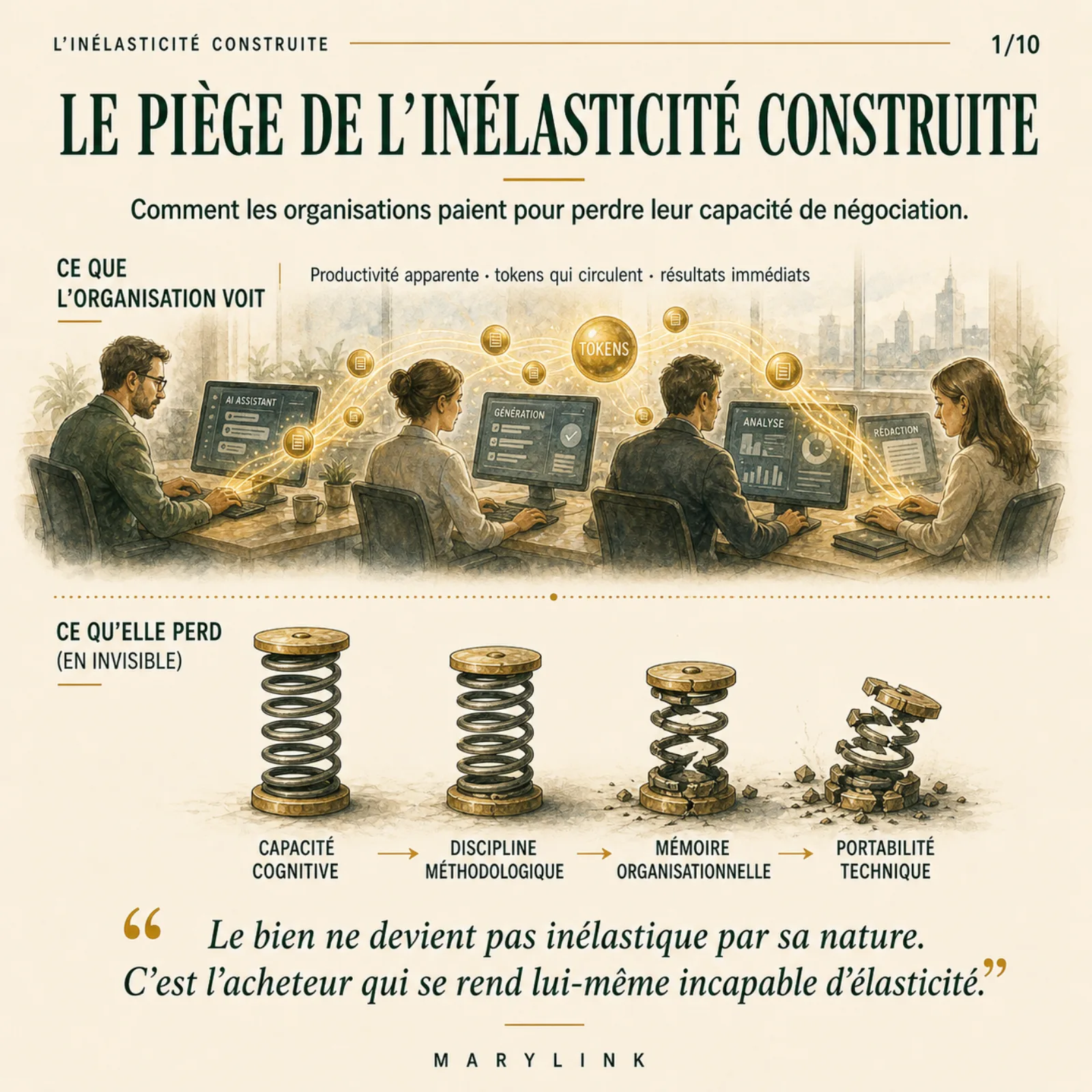
In economics, a good is inelastic when the buyer keeps paying even as the price climbs sharply, because they can no longer do without it. With generative AI, the good isn't inelastic by nature: the organization is the one that, step by step, makes itself unable to say no. Inelasticity isn't suffered, it's built. And what is built can be undone.
Price was neutralized. It no longer is
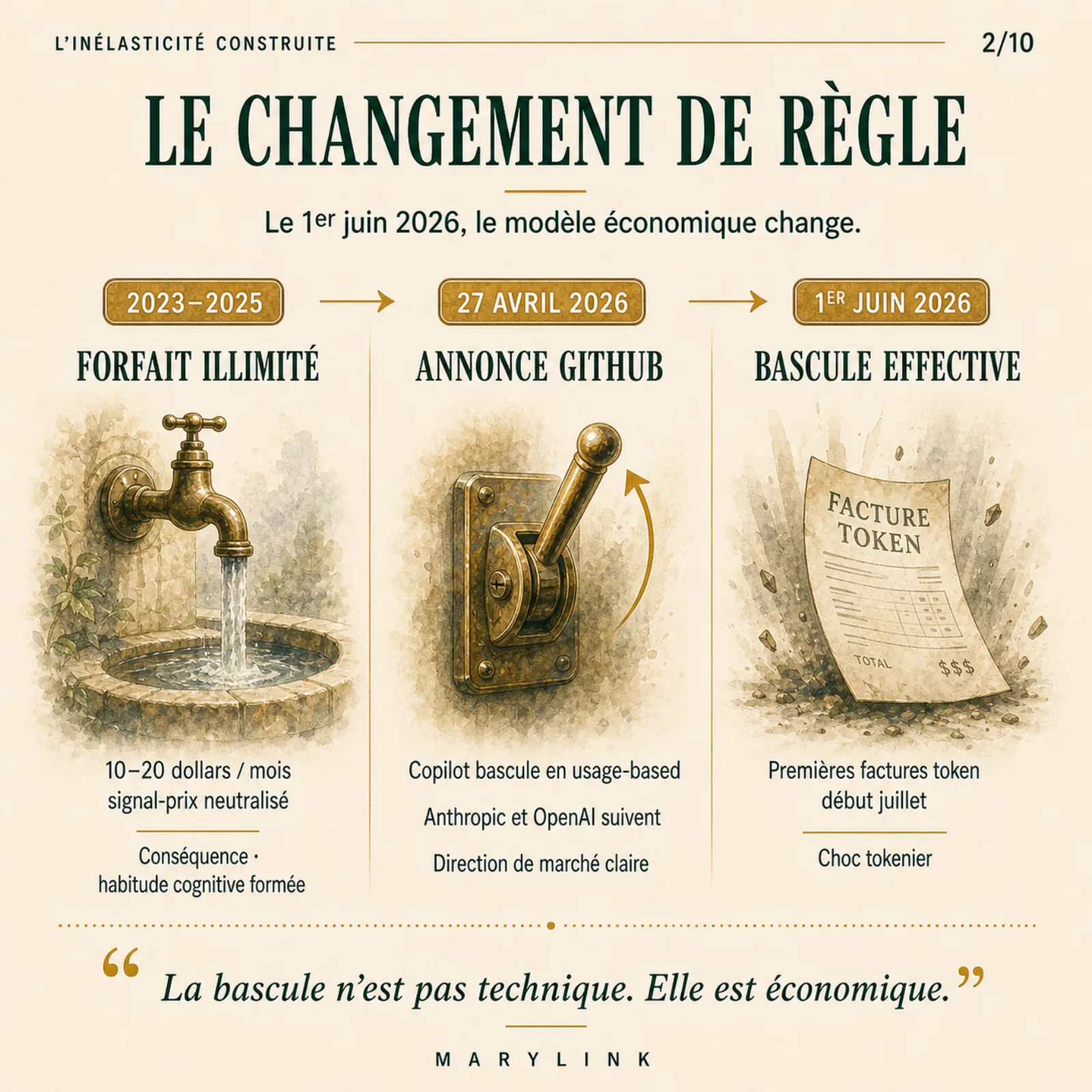
For two years, generative AI was sold as an unlimited plan at ten or twenty dollars a month. At that price, cost was economically neutralized: the marginal cost of one more request fell to zero in the user's mind. You don't budget for what costs nothing. That is precisely where the habit forms.
On April 27, 2026, GitHub switches Copilot to usage-based billing; the major providers follow. The switch isn't technical, the product doesn't change. It's economic: price becomes a variable again, at the exact moment the organization has lost the reflex to look at it.
Selling below cost isn't a mistake, it's a calculation
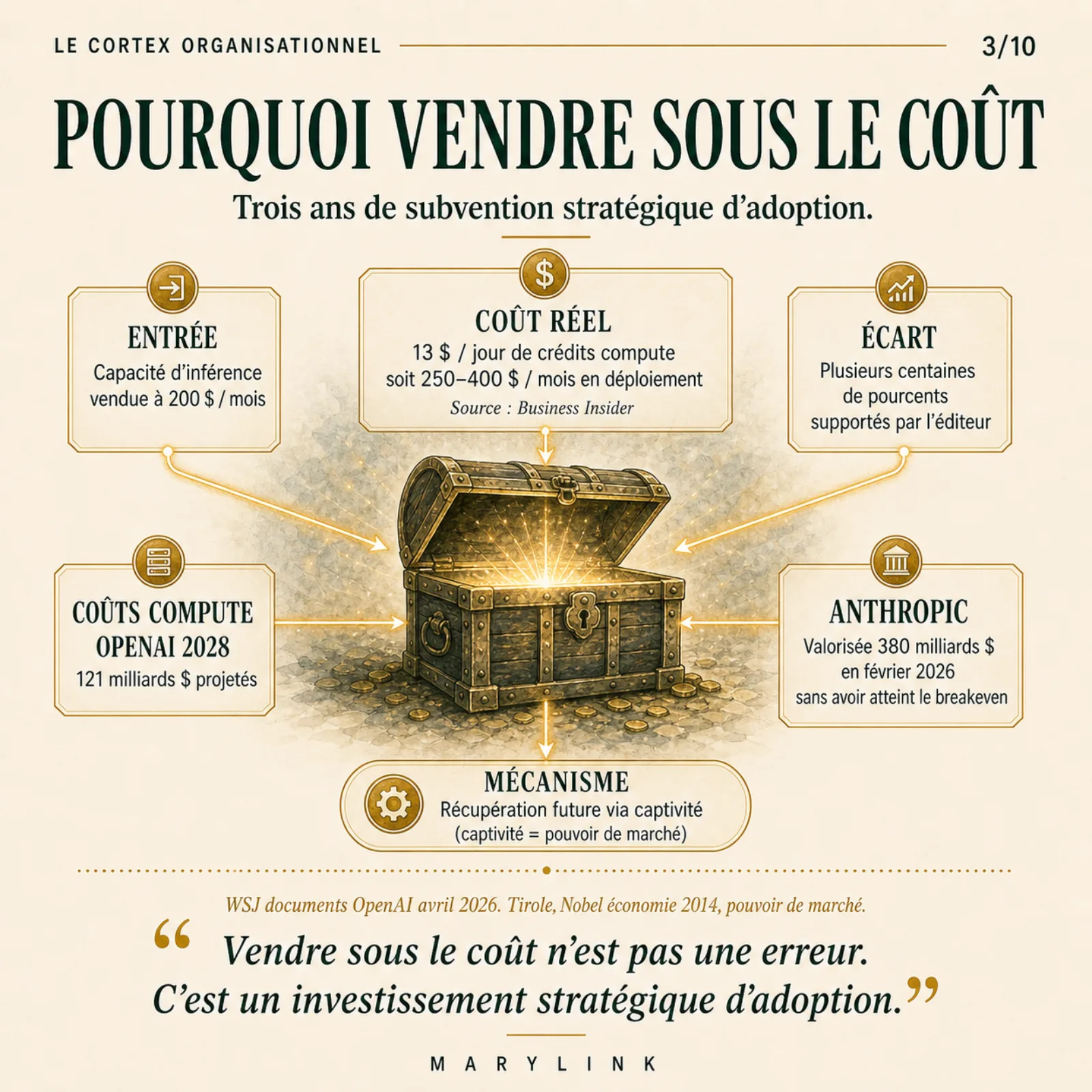
The numbers make the logic plain. Business Insider puts the real cost of heavy use at around thirteen dollars a day, while the subscriber pays a fraction of that; in April 2026 the WSJ documents deliberate negative margins at OpenAI, whose compute costs are projected at 121 billion dollars by 2028. Anthropic is valued at 380 billion in February 2026 without having reached breakeven.
This isn't philanthropy. As Jean Tirole showed on market power, subsidizing adoption is recouped later, through lock-in. The gap between price paid and real cost isn't a favor: it's the advance taken out on your future inelasticity.
Three mechanisms that deepen one another
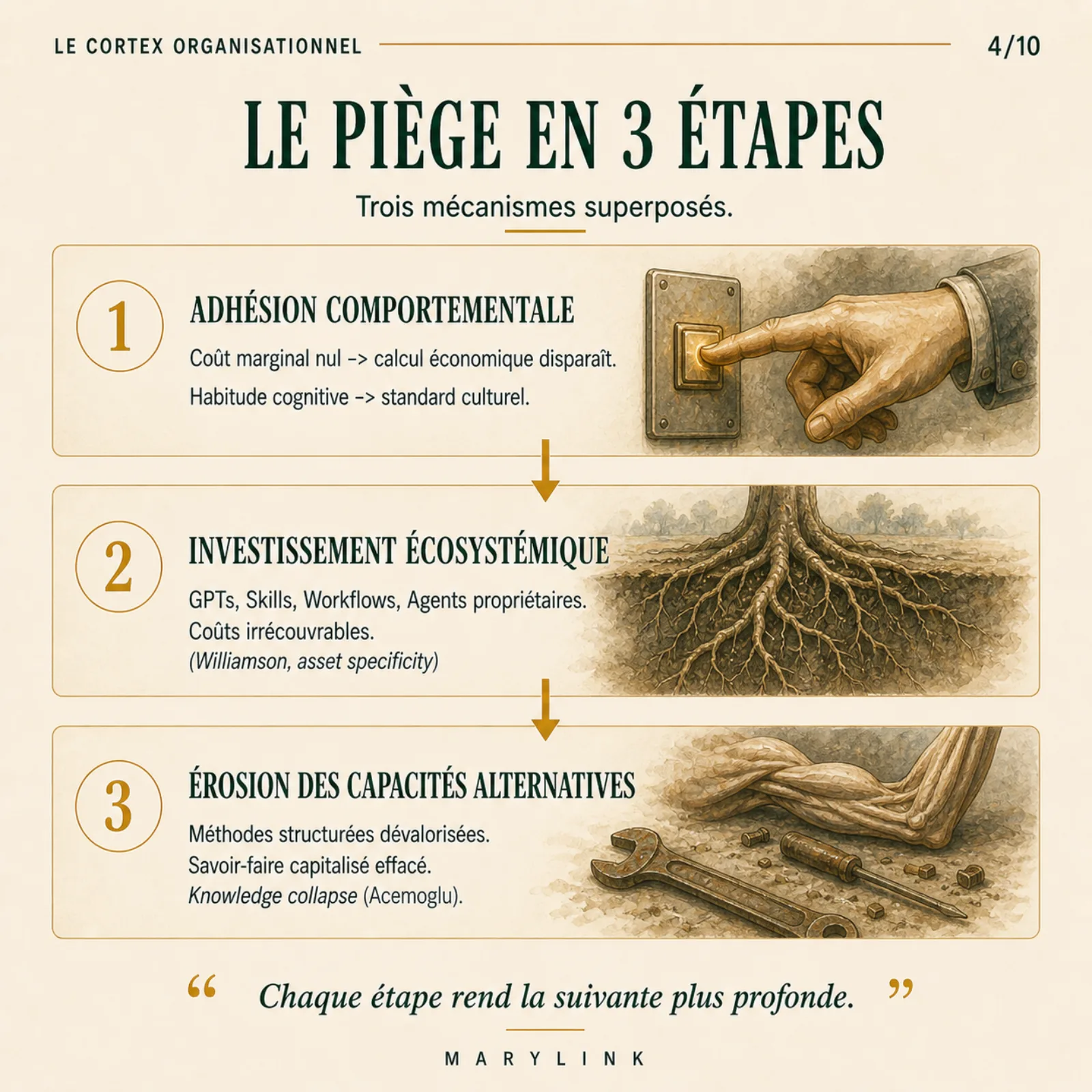
Inelasticity doesn't drop all at once; it settles in three layers. Behavioral adoption: at zero marginal cost, the economic calculation disappears and the habit becomes a cultural standard. Ecosystem investment: you build GPTs, Skills, workflows, proprietary agents, sunk costs, what Williamson called asset specificity.
Erosion of alternative capabilities, finally: through constant delegation, structured methods lose their value and know-how fades. Each stage makes the next one deeper, and the step-by-step of that ratchet is what the token trap lays out.
The point where dependence turns irreversible
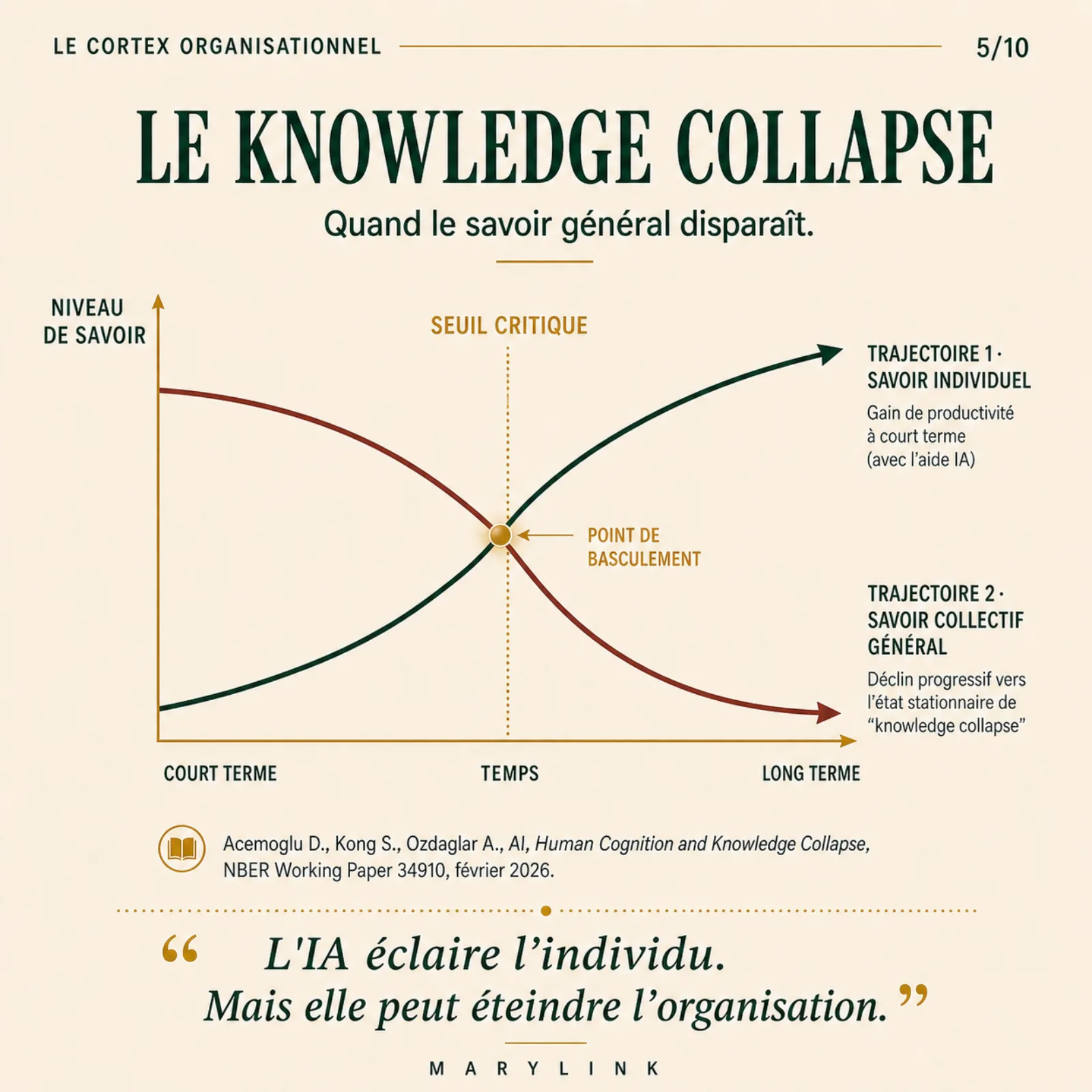
The erosion has a name and a curve. Acemoglu, Kong and Ozdaglar model it in AI, Human Cognition and Knowledge CollapseKnowledge collapseThe erosion of institutional memory when AI accelerates execution but nothing gets capitalized. (NBER Working Paper 34910, February 2026): in the short term, AI illuminates the individual and productivity rises. But past a critical threshold, general collective knowledge declines toward a stationary state, knowledge collapse.
Economically, that tipping point is the moment inelasticity stops being a choice. Before it, the organization could still do without the tool. After it, it no longer holds, in-house, the means to work any other way. AI illuminates the individual; it can extinguish the organization.

The most effective trap is the one you walk into through the front door.Intelligence des organisations
The four springs of your elasticity
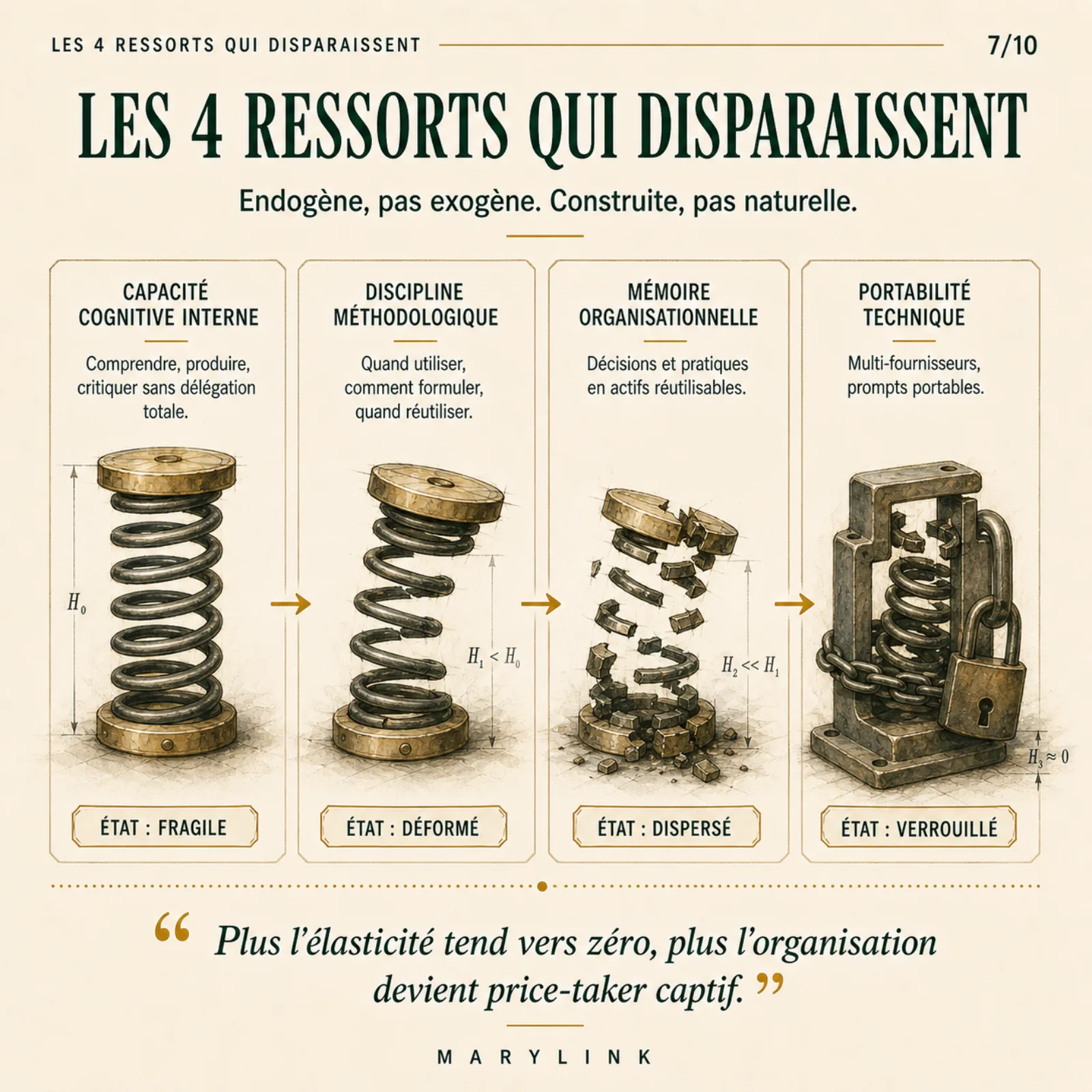
An organization's elasticity is measured by four springs. Internal cognitive capacity: to understand, produce and critique without delegating everything. Methodological discipline: knowing when, how and why to use the tool. Organizational memory: turning decisions and practicesPracticeA unit of know-how captured in Marylink: not a document but an executable structure (content, prompt, rules, style). into reusableReuseThe same practice serving many times, across many spaces, the key measure of the Practice Graph's value. assets. Technical portability: staying multi-vendor, with transferable prompts and workflows.
The decisive point fits in one word: endogenous. These springs aren't worn down by the market, they are let go from within. Inelasticity isn't natural, it's built, and the closer it tends to zero, the more the organization becomes a captive price-taker, doomed to accept whatever price it's shown.
Why "there's always open source" isn't enough
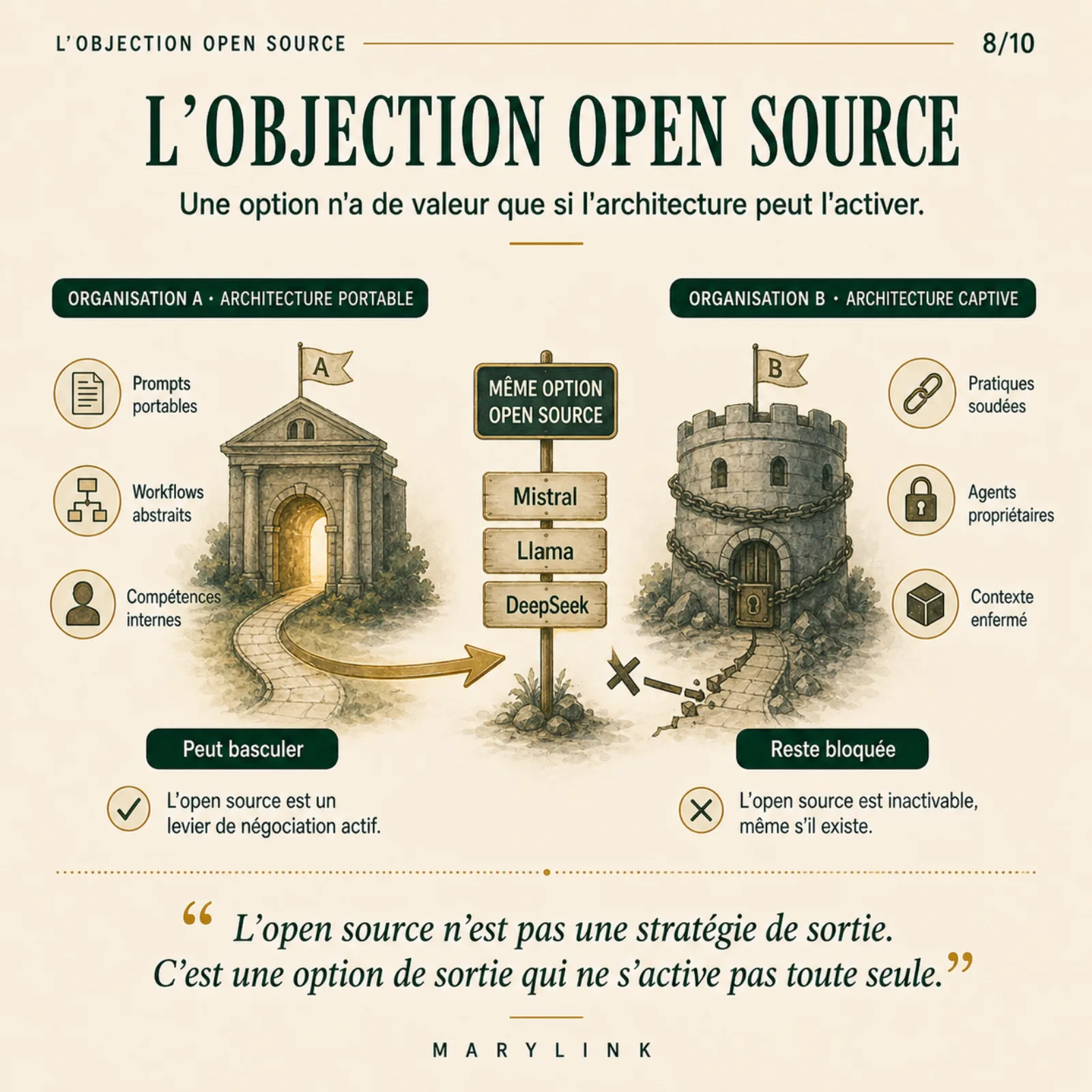
The objection comes at once: if the price rises, we'll switch to an open model, Mistral, Llama, DeepSeek. Economically, an exit option only has value if it is activatable. Two organizations facing the same open alternative are not in the same position.
The one that kept portable prompts, abstract workflows and internal skills can actually switch: the option carries weight in the negotiation. The one whose practices are welded to a vendor and whose context is locked in stays blocked, even though the alternative exists. Open source isn't an exit strategy; it's an exit option that doesn't activate on its own, what arms it is the sovereignty of your architecture.
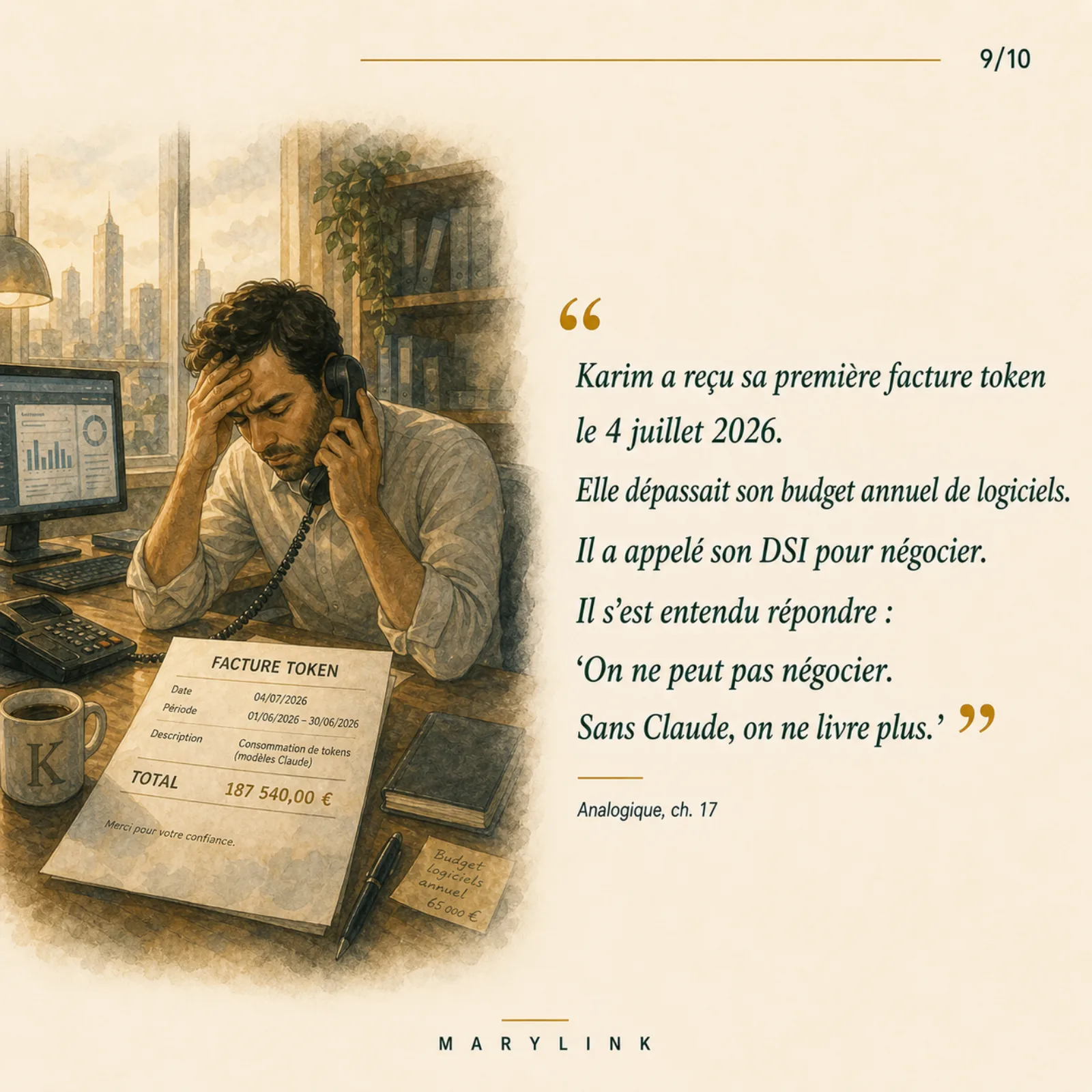
Inelasticity isn't a textbook abstraction; it's a scene. In Analogique (ch. 17), on July 4, 2026 Karim receives his first token bill: 187,540 euros, beyond his entire annual software budget. He calls his IT director to negotiate.
The answer is two sentences: "We can't negotiate. Without Claude, we no longer deliver." That is built-in inelasticity, not a high price, but the impossibility of saying no. Price is no longer a variable; it has become a condition of existence.

Captivity or architectural sovereignty
The counter-power to AI pricing is neither a moral question nor a commercial arm-wrestle: it is architectural. You stay elastic only if, by design, you've kept the means to work another way, cognition, method, memory, portability. That is exactly what governing your practices as a shared asset preserves. The only question that matters: which springs do you have left?