
The subsidised pricing trap
The real problem is not per-token billing. It is the dependence built behind today’s subsidised prices. Companies are not paying a new price; they are paying the price of their own dependence.


How the market shifted
Major AI providers are shifting their offers toward usage-based models. GitHub Copilot moves from a useful-unlimited logic to a consumed-credits logic. OpenAI and Anthropic push hybrid offers blending seatsSeatA named user license. Marylink bills per seat, adjustable at any time., usage and agentic services.
The real reading: this is not a technical detail, it is a shift in bargaining power. The central issue is not the headline price, but the power asymmetry created by the subsidised period.
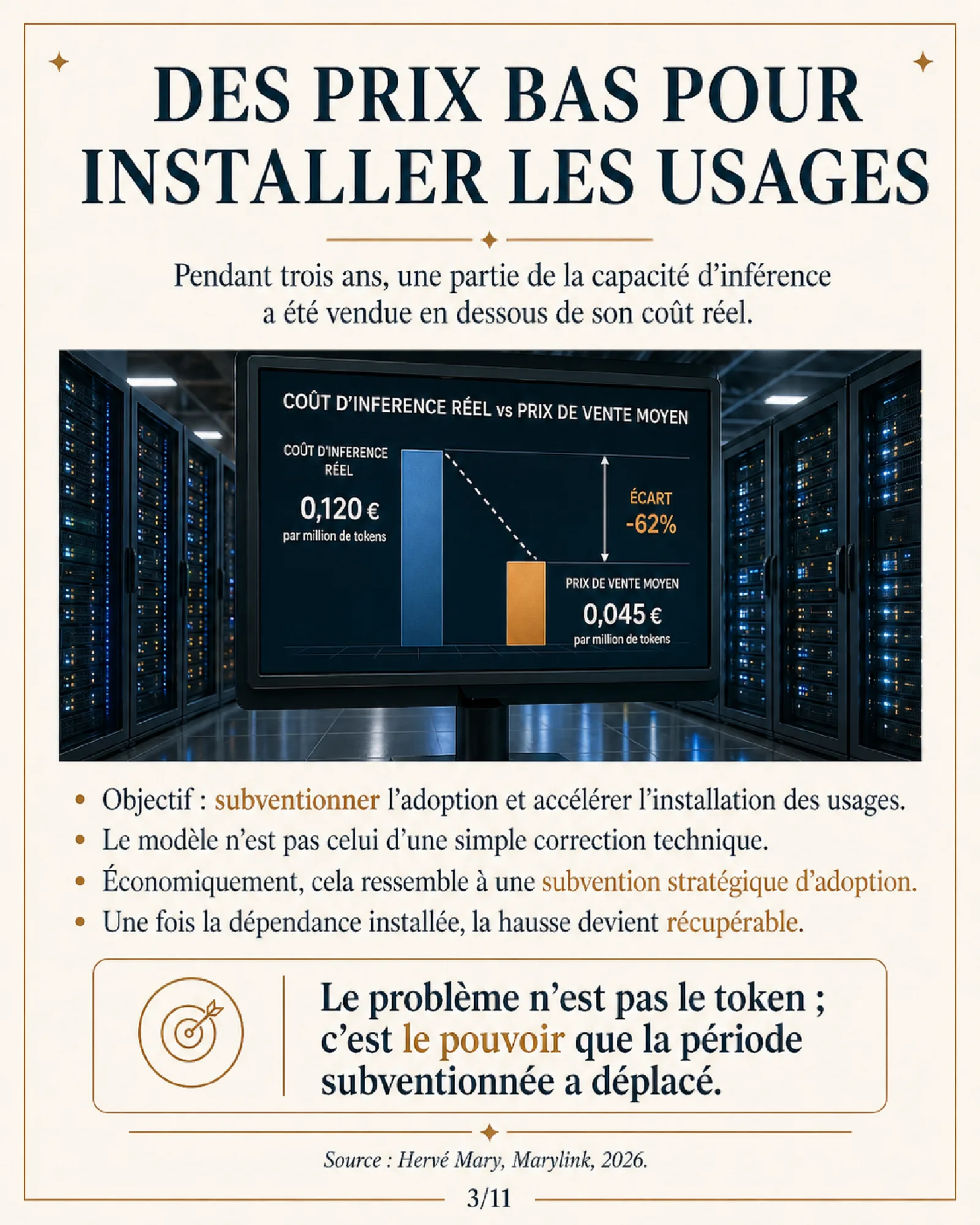
Low prices to install usage
For three years, part of inference capacity was sold below its real cost: €0.120 per million tokens on the cost side, versus an €0.045 average selling price, a −62% gap.
The goal is to subsidise adoption and accelerate the installation of usage. Economically, it looks like a strategic adoption subsidy. Once dependence is installed, the increase becomes recoverable. The problem is not the token; it is the power the subsidised period has shifted.

The trap closes in 3 stages
Captivity is not created in one step: it builds by accumulation. 1. Usage habit, low prices make consumption reflexive. 2. Ecosystem investment, tools, prompts and workflows become provider-specific. 3. Loss of alternatives, internal capabilities and lean methods atrophy.
Dependence comes from the sum of three movements: habit, specific investment and erosion of alternatives.

Stage 1, the usage habit
When the price signal disappears, consumption becomes a reflex. When marginal cost is near zero, economic calculation vanishes. People reprompt to check, relaunch an agent, pile up iterations.
Usage becomes a mental habit, then a company-wide cultural standard. What was a convenience becomes a productivity norm. Very low prices don’t just create usage: they create a habit.

Stage 2, investing in the ecosystem
During the adoption phase, users invest in the provider’s universe: custom GPTs, Skills, Projects and automated workflows; prompt libraries, integrations and internal practicesPracticeA unit of know-how captured in Marylink: not a document but an executable structure (content, prompt, rules, style)..
These productivity gains also become sunk costs. The more provider-specific the asset, the more costly switching becomes. Lock-in is born from the specificity of assets.

Stage 3, the loss of alternatives
While consumption rises, other ways of producing atrophy. Structured working methods are culturally devalued; accumulated know-how is used less; collective intelligence and reuseReuseThe same practice serving many times, across many spaces, the key measure of the Practice Graph's value. recede.
The organisation gradually loses its ability to do things differently. The more alternative capabilities disappear, the more costly it becomes to leave.
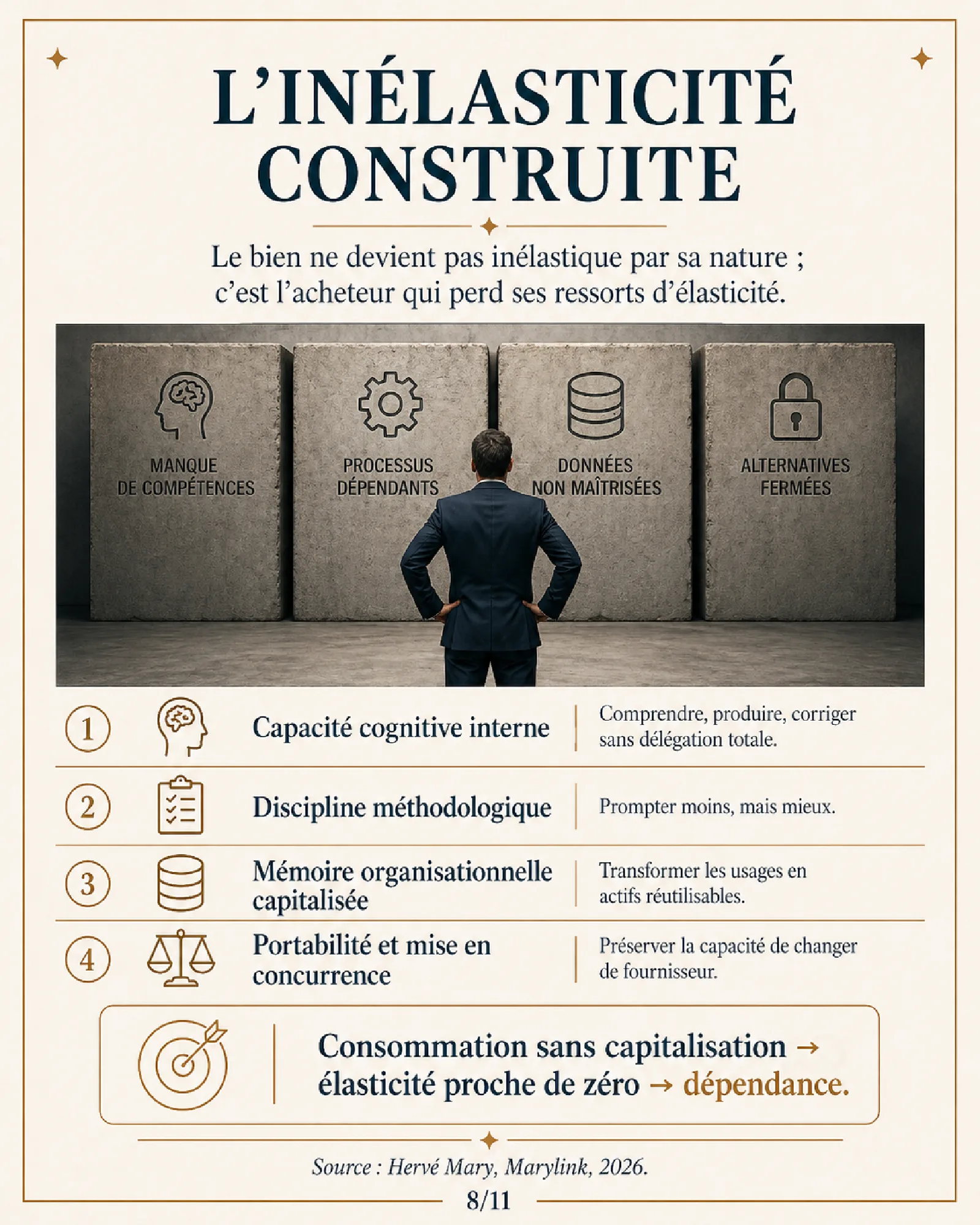
Built-in inelasticity
A good does not become inelastic by nature; it is the buyer who loses their elasticity. Four levers preserve it: 1. Internal cognitive capacity (understand, produce, correct without total delegation); 2. Methodological discipline (prompt less, but better).
3. Capitalised organisational memory (turn usage into reusable assets); 4. Portability and competition (keep the ability to switch provider). Consumption without capitalisation → near-zero elasticity → dependence.
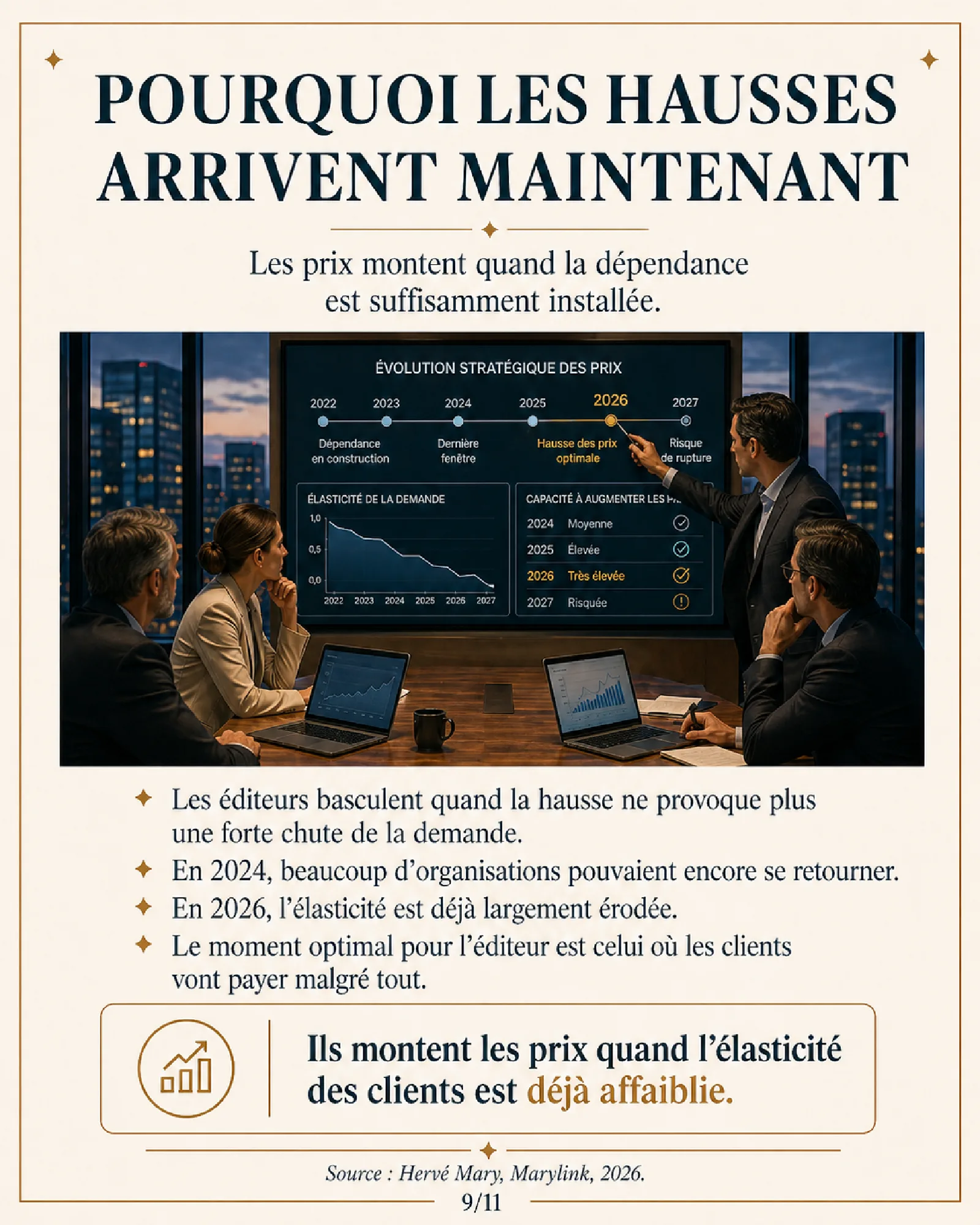
Why the increases come now
Prices rise once dependence is sufficiently installed. Vendors switch when an increase no longer triggers a sharp drop in demand. In 2024, many organisations could still pivot; in 2026, elasticity is already largely eroded.
The optimal moment for the vendor is when customers will pay anyway. They raise prices when customer elasticity is already weakened.

How to take back control
The way out is not moral: it is architectural. 1. Reduce useless regeneration. 2. Turn conversations into assets. 3. Version practices and decisions.
4. Keep prompts and workflows portable. 5. Measure the value capitalised per token. Goal: turn every token into a reusable asset and restore bargaining power.

When the price rises, what does demand do?
This is price elasticity of demand. If a price increase sharply lowers demand, demand is elastic; if demand barely moves, it is inelastic. When I have alternatives, I can reduce, compare or switch: demand stays elastic. When I no longer have an alternative, I must continue, I pay despite the increase, and my bargaining power falls: demand becomes inelastic. The fewer the alternatives, the less price restrains demand, exactly the trap of built-in inelasticity. The answer is not to flee AI, but to consume it while capitalising. See how Marylink turns every token into a reusable asset.