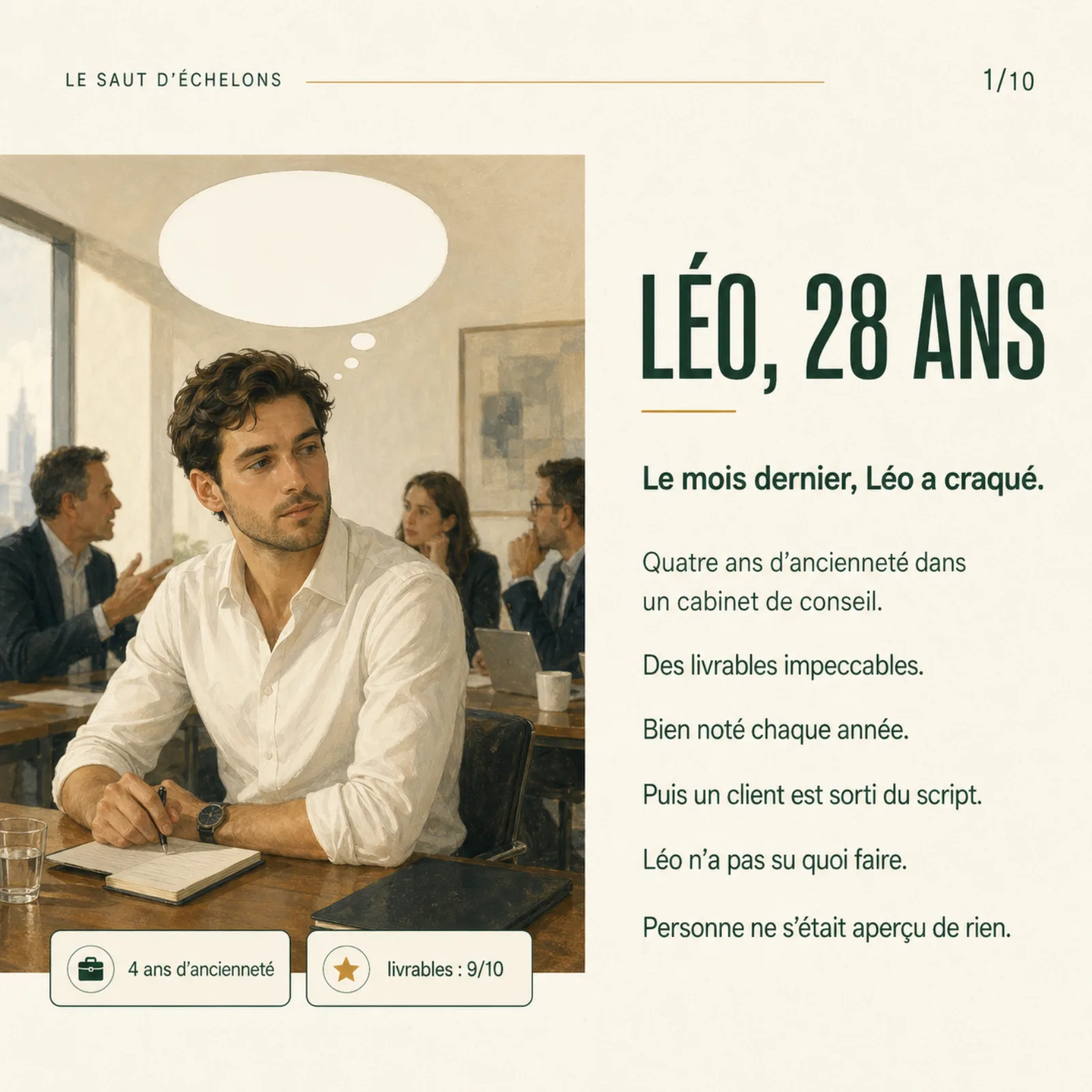
Skipping the rungs
Léo, 28, ships flawless deliverables. Then a client stepsValidation stepA stage in a publication's path (draft → review → approved), with rules that gate each transition. off-script and he doesn't know what to do, and no one had noticed. With AI, the deliverable climbs faster than experience: rungs get skipped instead of earned. This carousel shows the gap it digs, and how to close it.
The Dreyfus ladder
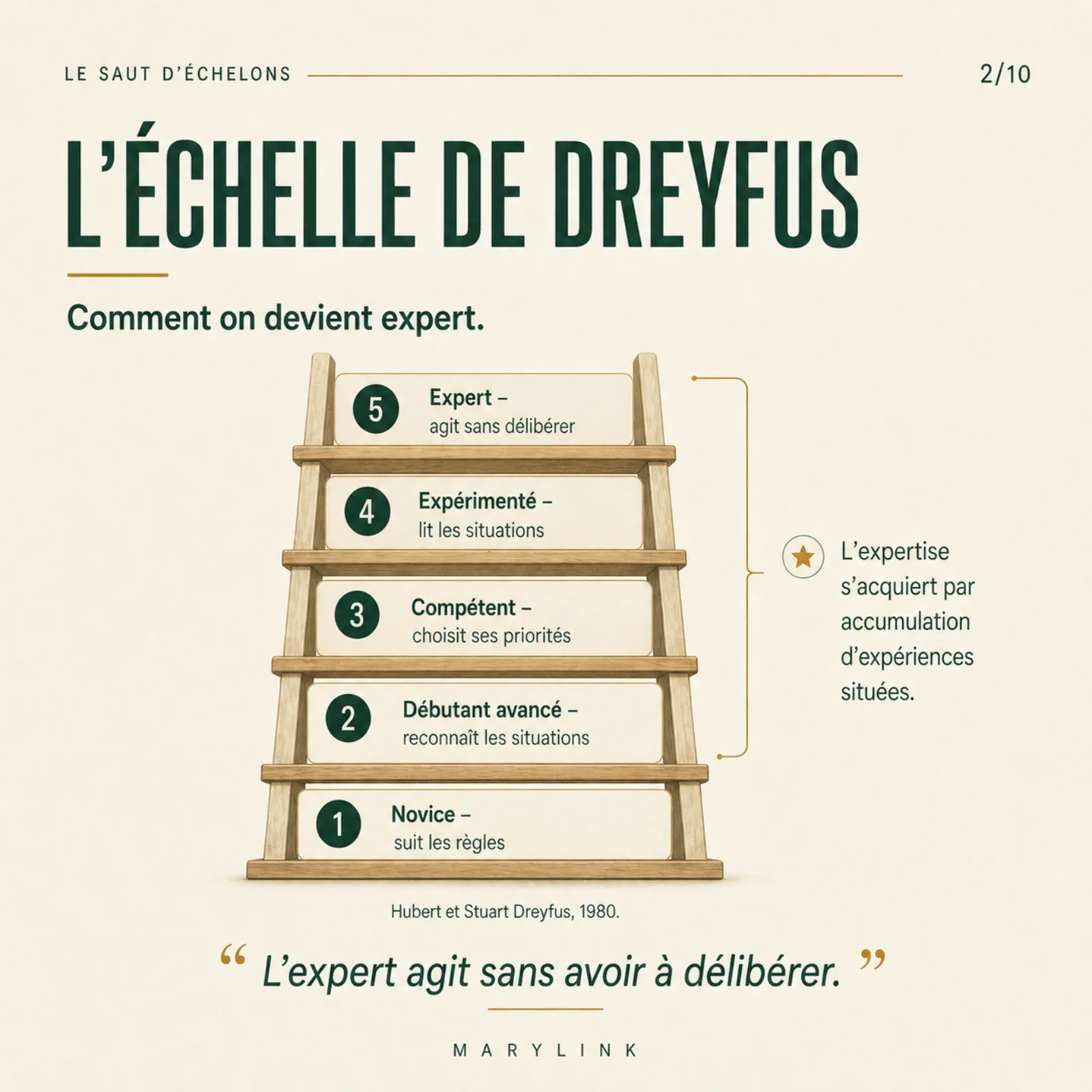
You become an expert through five rungs: 1. Novice (follows the rules), 2. Advanced beginner (recognizes situations), 3. Competent (sets priorities), 4. Proficient (reads situations), 5. Expert (acts without deliberating).
Expertise is built by accumulating situated experience. 'The expert acts without having to deliberate.'
Skipping rungs
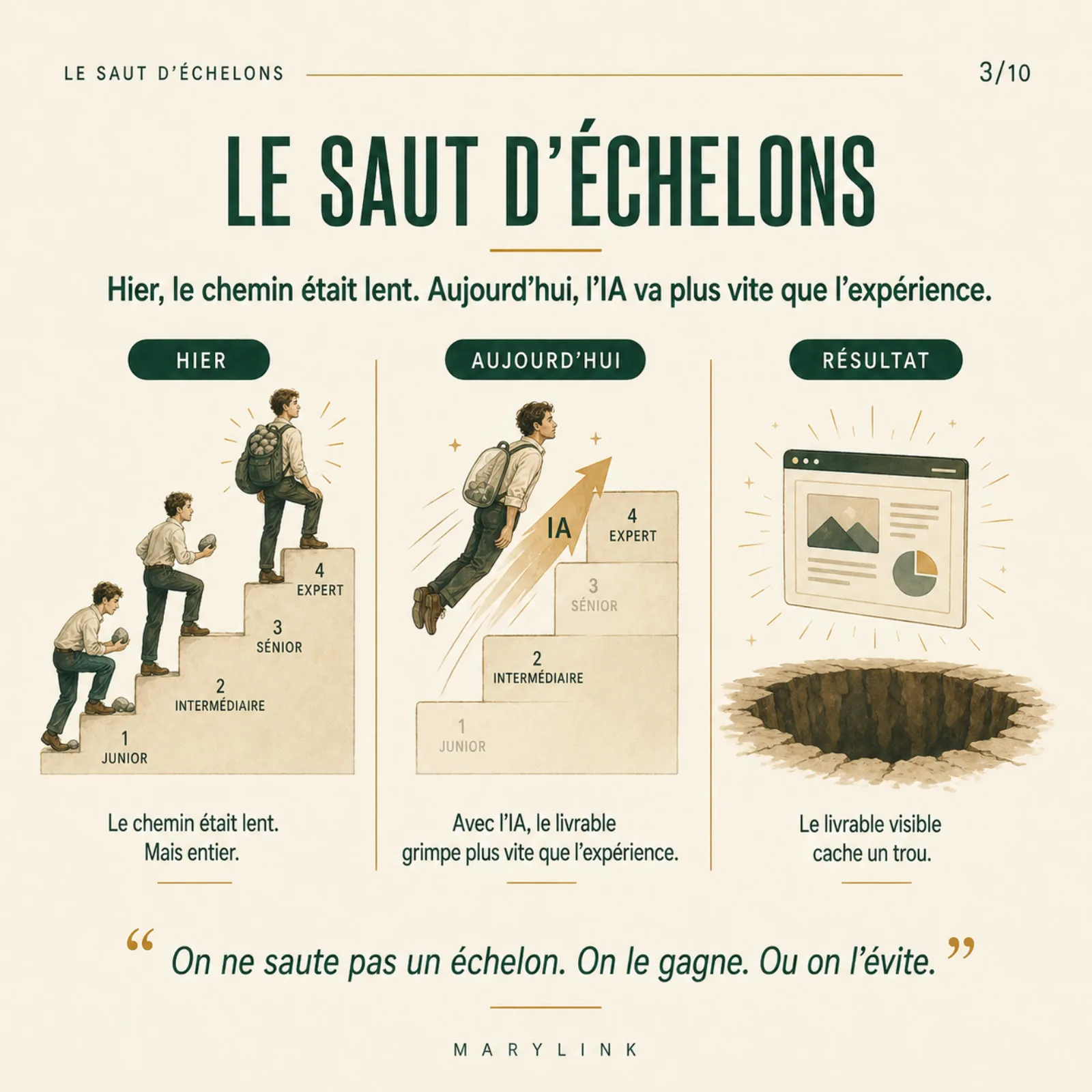
Yesterday, the path was slow but whole: junior, intermediate, senior, expert. Today, with AI, the deliverable climbs faster than experience.
The visible deliverable hides a hole. 'You don't skip a rung. You earn it. Or you dodge it.'
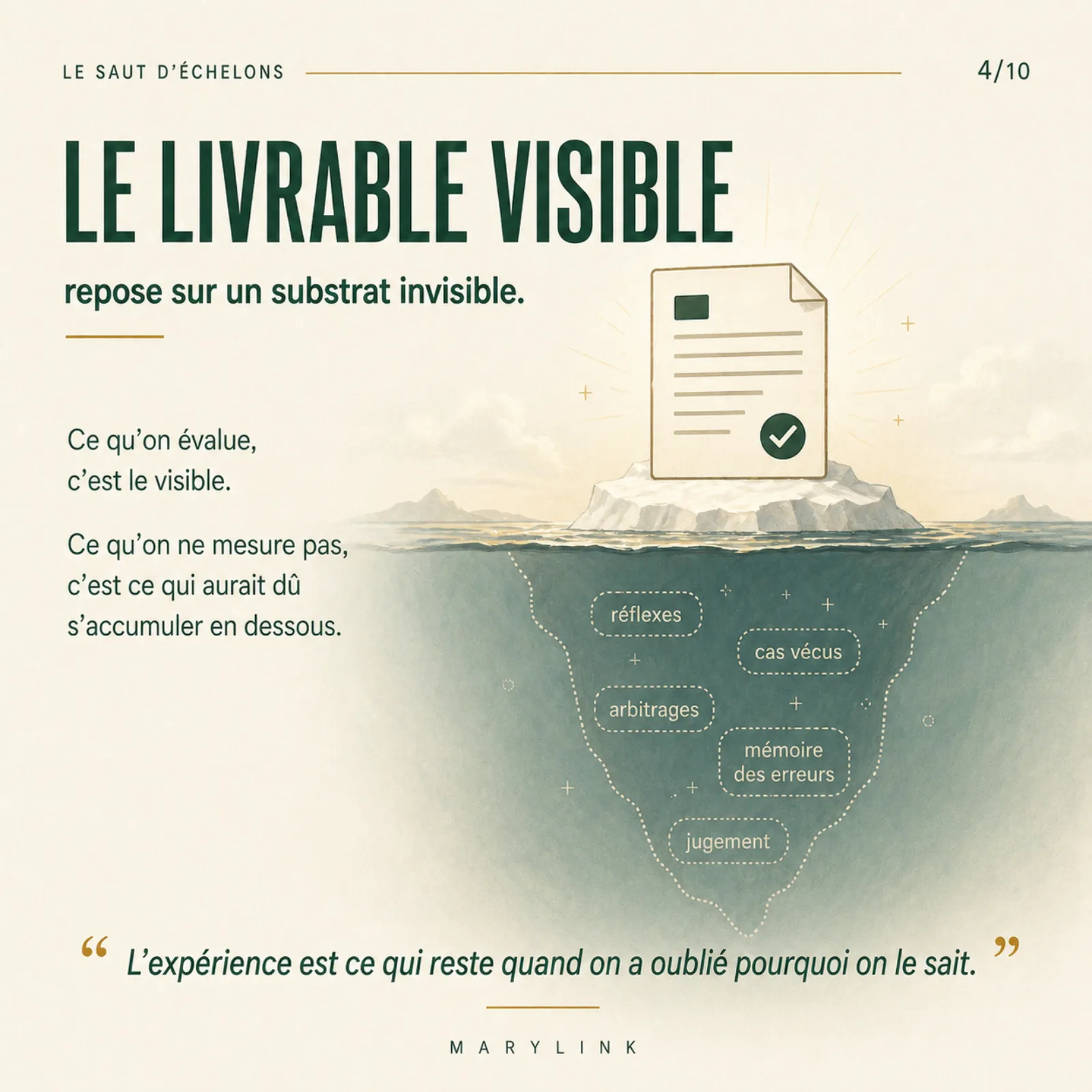
The visible deliverable rests on an invisible substrate
What we evaluate is the visible part. What we don't measure is what should have accumulated beneath it: reflexes, lived cases, trade-offs, memory of mistakes, judgment.
'Experience is what remains once you've forgotten why you know it.'
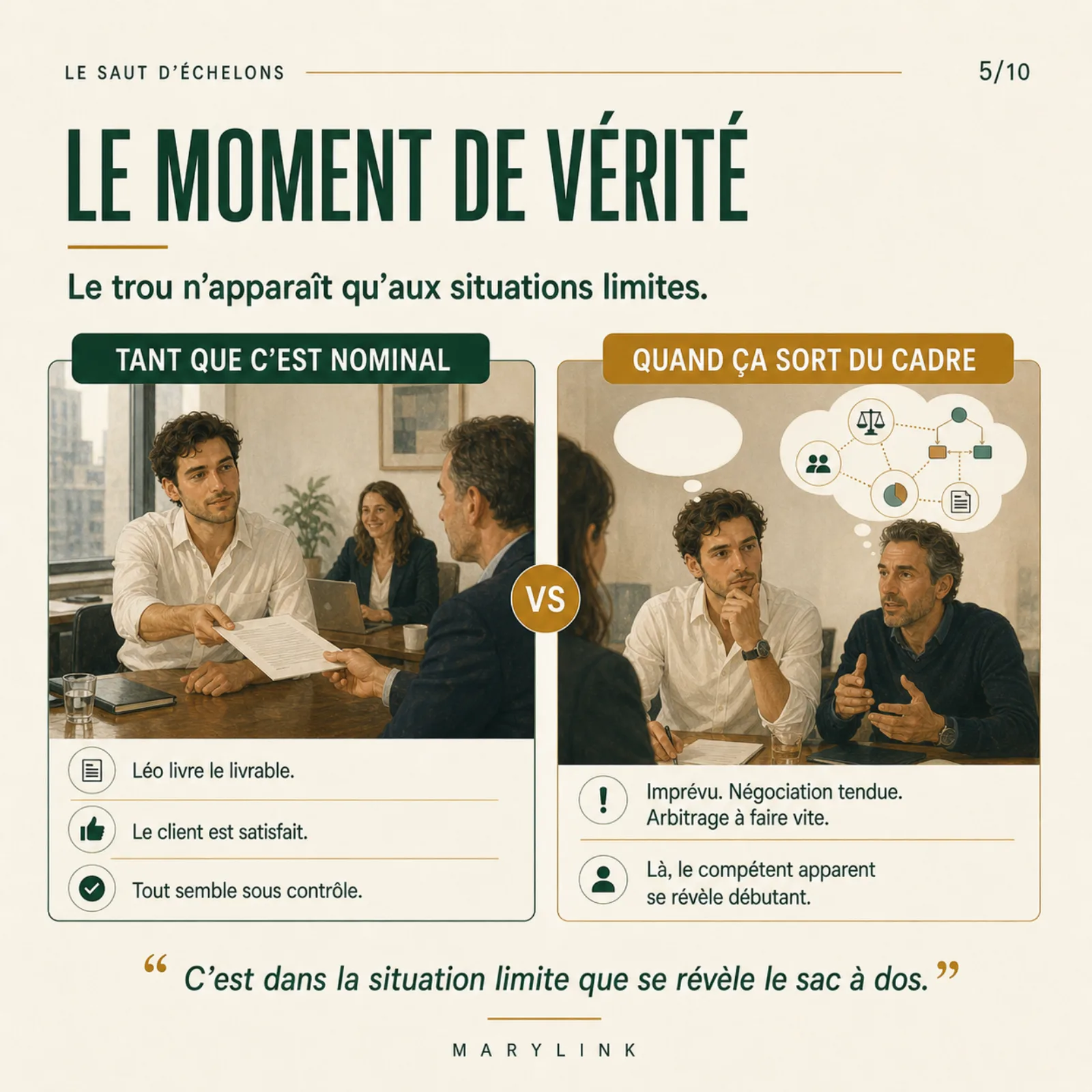
The moment of truth
As long as it's nominal: Léo delivers, the client is satisfied, everything seems under control. When it steps off-script: the unexpected, a tense negotiation, a fast call to make, that's when the seemingly competent turns out to be a beginner.
The gap only shows up in edge situations. 'It's in the edge case that the backpack is revealed.'
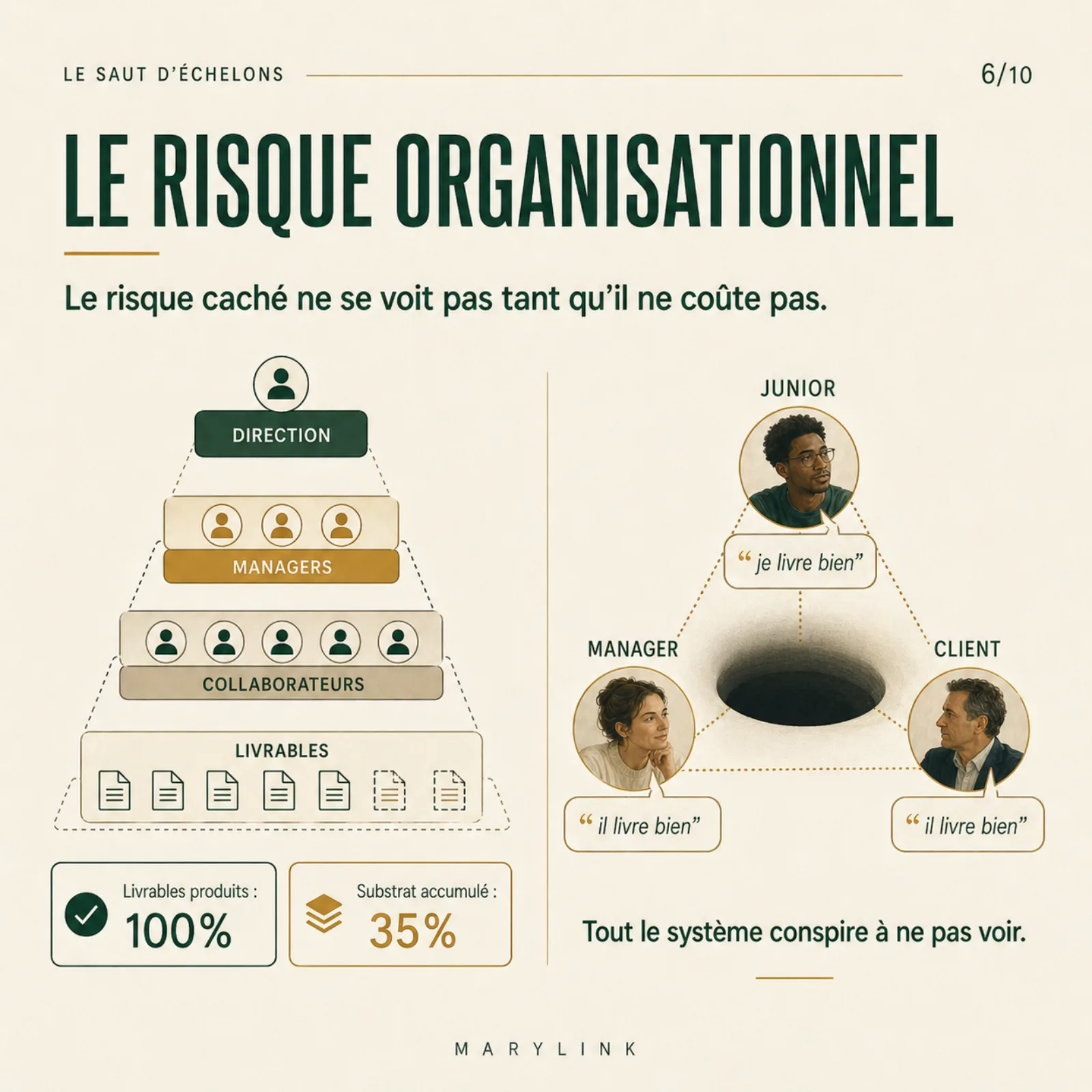
The organizational risk
Hidden risk stays invisible as long as it costs nothing. Deliverables produced show 100%, but the substrate accumulated is only 35%.
The junior says 'I deliver well,' the manager and the client say 'he delivers well.' The whole system conspires not to see it.
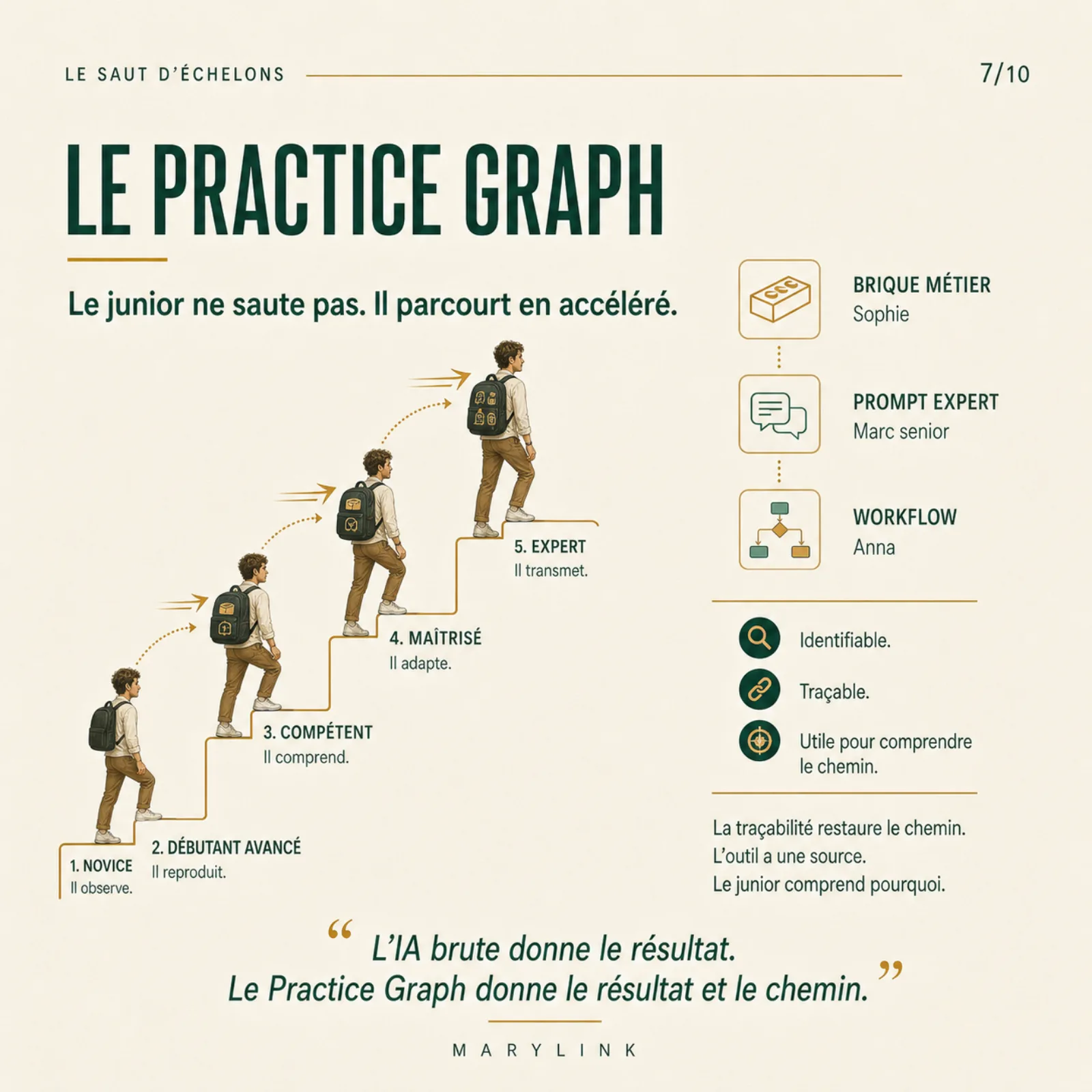
The Practice Graph
The junior doesn't skip: he runs the five rungs at speed (observes, reproduces, understands, adapts, transmits). Each tool he uses, domain brick (Sophie), expert prompt (Marc, senior), workflow (Anna), is identifiable, traceable and useful for understanding the path.
Traceability restores the path: the tool has a source, the junior understands why. 'Raw AI gives the result. The Practice GraphPractice GraphThe living architecture that links your practices, concepts, roles and spaces, executable by your teams and by AI. gives the result and the path.'
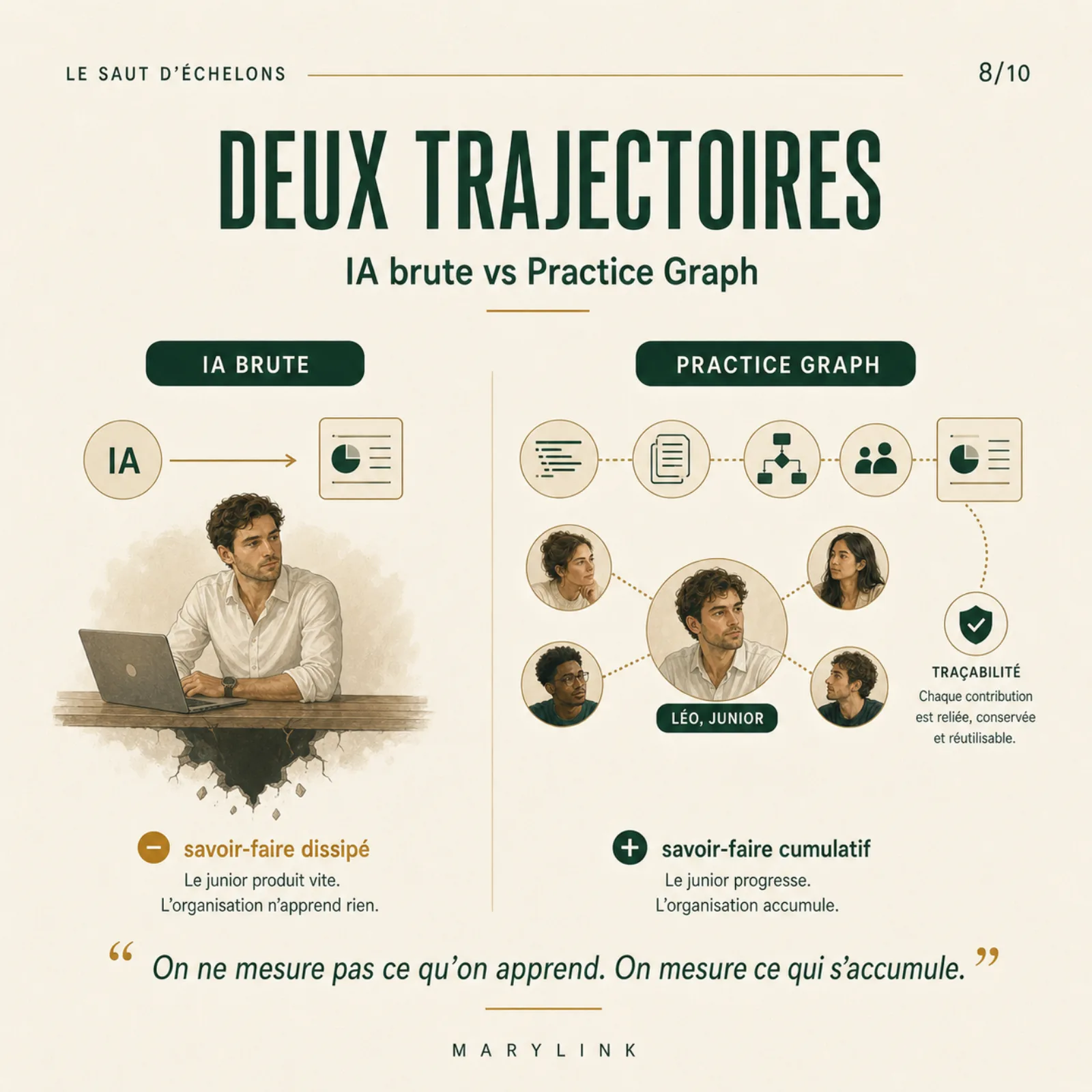
Two trajectories
Raw AI, dissipated know-how: the junior produces fast, the organization learns nothing. PracticePracticeA unit of know-how captured in Marylink: not a document but an executable structure (content, prompt, rules, style). Graph, cumulative know-how: the junior progresses, the organization accumulates; every contribution is linked, kept and reusableReuseThe same practice serving many times, across many spaces, the key measure of the Practice Graph's value..
'We don't measure what we learn. We measure what accumulates.'
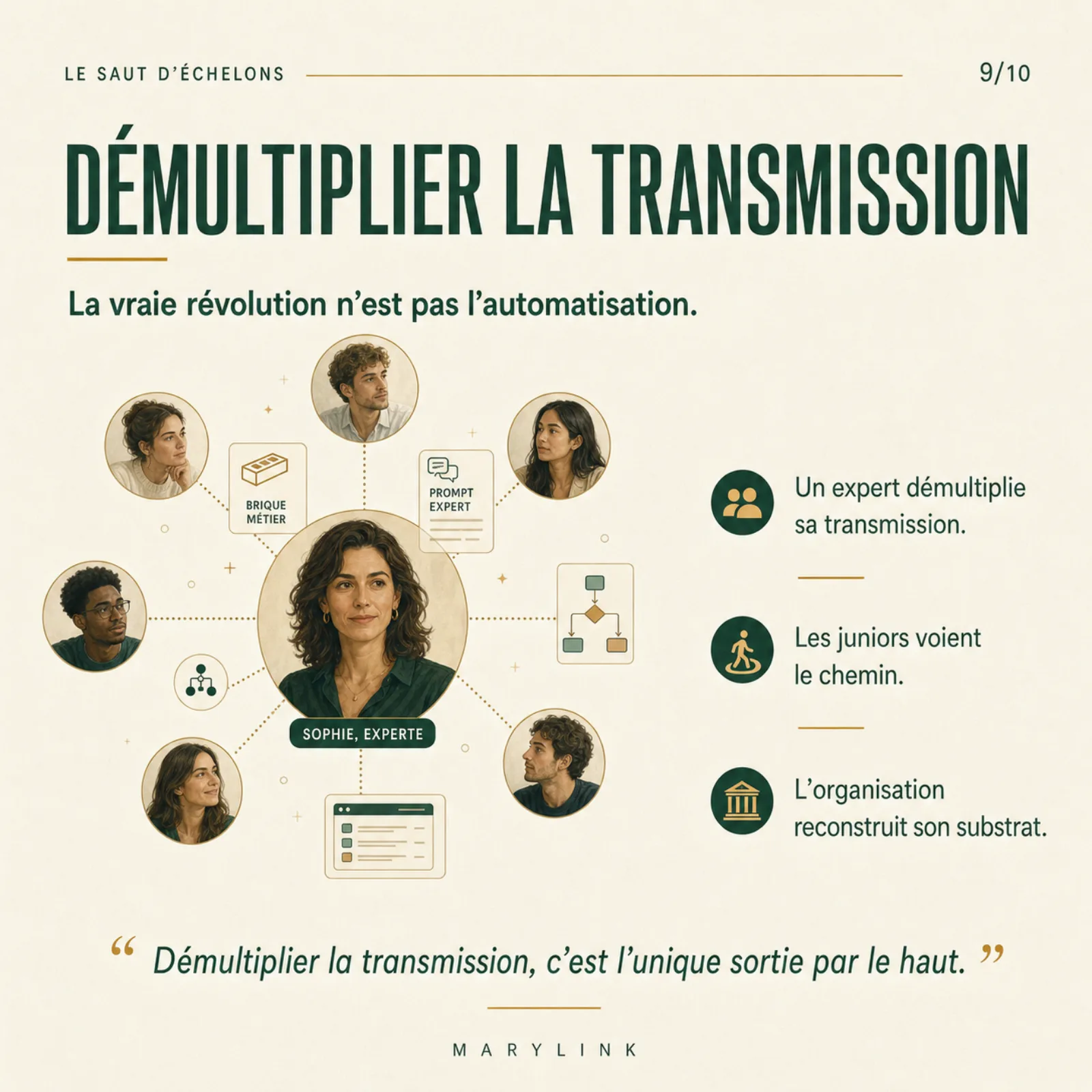
Multiplying transmission
The real revolution isn't automation. An expert multiplies their transmission: juniors see the path, and the organization rebuilds its substrate.
'Multiplying transmission is the only way out at the top.'
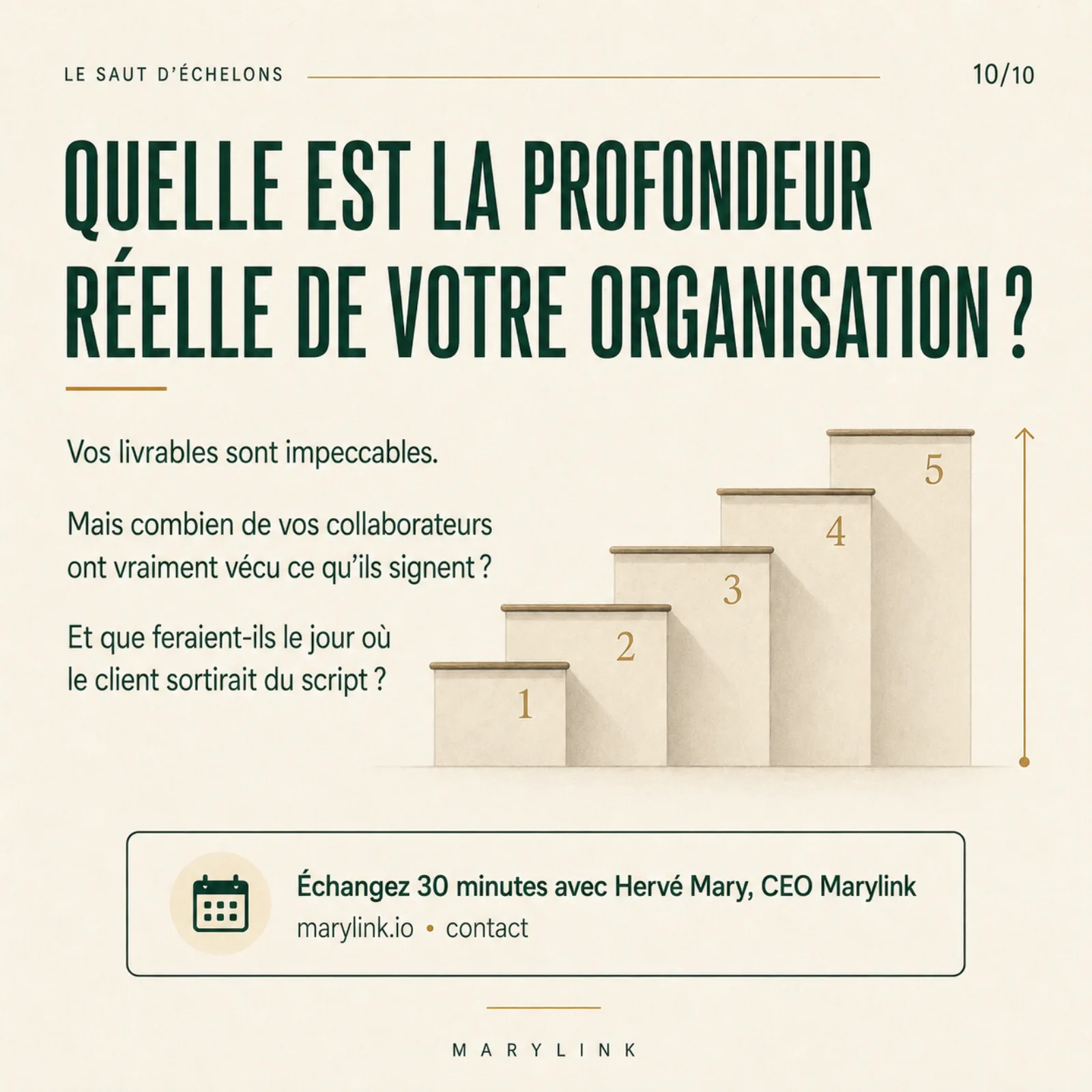
What is the real depth of your organization?
Your deliverables are flawless. But how many of your people have truly lived what they sign, and what would they do the day a client stepped off-script? Marylink restores the path beneath the deliverable so the organization accumulates again. Talk 30 minutes with Hervé Mary, CEO of Marylink.